
Top 5 Last-Minute Revision Strategies for MBA Entrance Exams (CAT, XAT, MAH-CET)
With MBA entrance exams like CAT 2026, XAT 2026, and MAH-CET 2026 around the corner, aspirants often enter a critical revision phase. The last few weeks can make a huge difference in percentile, but only if you revise smartly. Overloading yourself with new concepts can backfire. The key is strategic, focused revision and practice.
Here’s a complete guide to last-minute revision strategies to help aspirants maximize their score.
Focus on High-Yield Topics
Not all topics contribute equally to your score. Identify high-frequency topics from previous years:
- Quantitative Ability (QA): Arithmetic, Algebra, Geometry, and Number Systems
- Data Interpretation & Logical Reasoning (DI-LR): Tables, Graphs, and Puzzles
- Verbal Ability & Reading Comprehension (VARC): RCs, Para Jumbles, Vocabulary
- Decision Making (DM) for XAT: Ethics & business judgment caselets
Strategy:
- Prioritize topics that appear every year and where you have medium-to-high accuracy.
- Avoid spending time on rarely asked or extremely time-consuming questions.
Revise Short Notes and Formula Sheets
Last-minute memory refresh is critical. Use your personalized short notes:
- Quant formulas, shortcuts, and DI tricks
- Vocabulary lists for VARC
- Logical reasoning and DM frameworks
- Previous year error log from mock tests
Pro Tip: Review daily, timed bursts (30–45 minutes per session) to strengthen memory recall without overwhelming yourself.
Take Sectional Mock Tests with Timed Practice
At this stage, full-length new concepts are risky. Focus on sectional tests and targeted mocks:
- Quant & DI-LR: 20–25 questions in 35–40 minutes per mock
- VARC: 3 RC passages or 15–20 verbal questions
- DM (XAT): Solve 3–4 caselets focusing on decision-making efficiency
Benefits:
- Reinforces accuracy and speed
- Highlights weak areas for last-minute tweaking
- Simulates exam stress and timing constraints
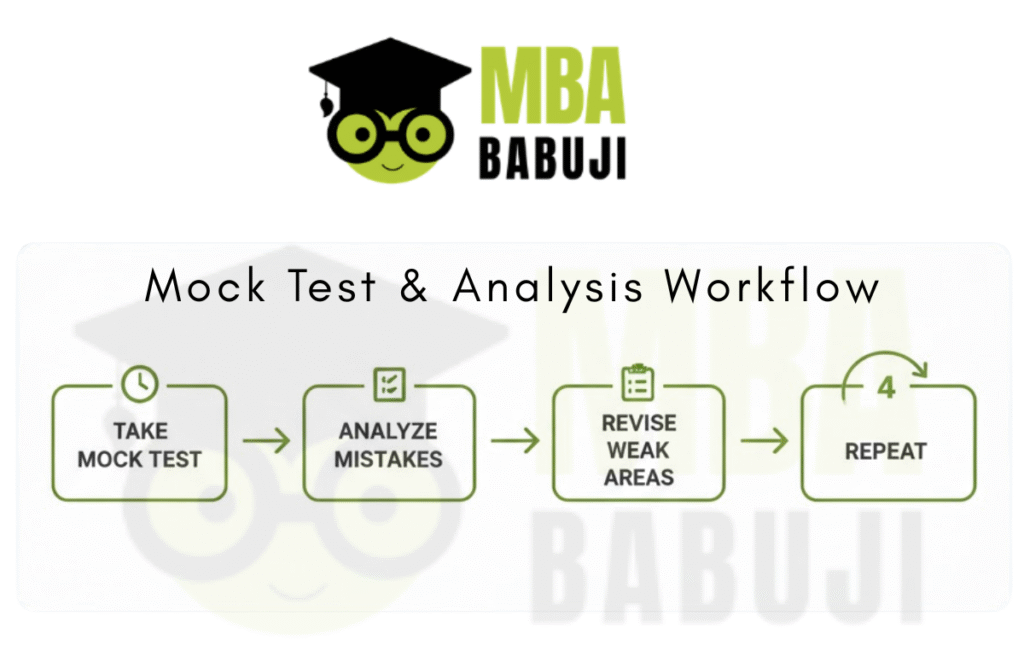
Analyze Mistakes Smartly
Taking mocks without post-mock analysis is wasted effort. Use your last 2–3 weeks wisely:
- Note repeated mistakes in QA shortcuts or LR puzzles
- Identify common RC comprehension errors or misreadings
- Track accuracy vs attempts for each section
- Adjust exam-day strategy: which questions to attempt first, which to skip
Pro Tip: Keep a revision error log handy — spend 10 minutes daily reviewing it to avoid repeating mistakes.
Manage Mental and Physical Energy
Exam stress can significantly affect focus and performance:
- Sleep: Minimum 6–7 hours to improve memory and alertness
- Breaks: Take 5–10 minute breaks every 1–1.5 hours during revision
- Diet & Hydration: Avoid junk food; stay hydrated
- Mindfulness or light exercise: Helps reduce stress and improve concentration

Remember: Overstudying in the last week often reduces efficiency. Mental clarity and alertness are more valuable than cramming.
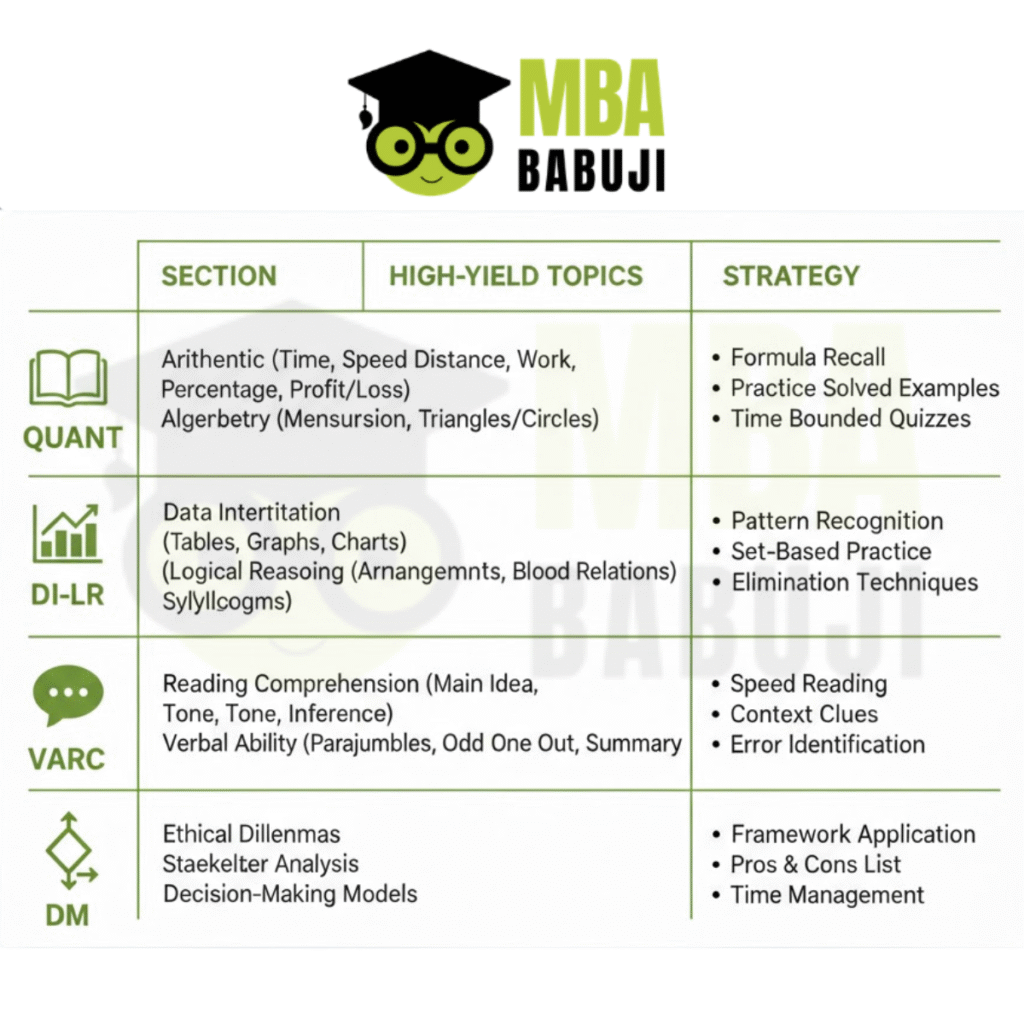
Quick Revision Checklist
| Section | High-Yield Focus | Suggested Strategy |
|---|---|---|
| Quant | Arithmetic, Algebra, Geometry | Short notes + formula practice |
| DI-LR | Tables, Graphs, Puzzles | Sectional timed mocks |
| VARC | RCs, Para Jumbles, Vocabulary | Last-minute RC practice + vocab review |
| DM (XAT) | Ethics, Business judgment | Solve 2–3 caselets/day, review frameworks |
| General | Mistake log | Daily 10–15 min review before sleep |
FAQs
Q1. Should I attempt new topics in the last week?
No. Focus on revision and high-yield topics. New topics can confuse or waste time.
Q2. How many mocks are ideal in the last two weeks?
5–6 full-length mocks or sectional practice daily is sufficient. Quality analysis is more important than quantity.
Q3. How to manage exam stress before D-day?
Follow proper sleep, light exercise, meditation, and timed revision. Avoid cramming new content.
Q4. Should I focus on my strong sections or weak sections?
Balance is key. Strengthen weak areas moderately, but consolidate strong sections to secure marks.