
The Smartest Way to Use Mock Tests in CAT, XAT & CET Preparation: Strategy, Analysis, and Score Improvement
Introduction: Why Mocks Don’t Help Everyone
Almost every CAT, XAT, and CET aspirant takes mock tests. Yet, only a small percentage see consistent improvement in their scores. Many students remain stuck in the same percentile range despite attempting multiple mocks every month.
The problem is not the number of mocks taken, but how mocks are used.
Mock tests are not just practice papers. When used correctly, they become diagnostic tools, strategy trainers, and performance simulators. When used poorly, they become stress generators with no learning value.
The smartest way to use mock tests focuses on strategy, structured analysis, and decision-making, not just performance.
Why Many Aspirants Fail to Improve Through Mocks
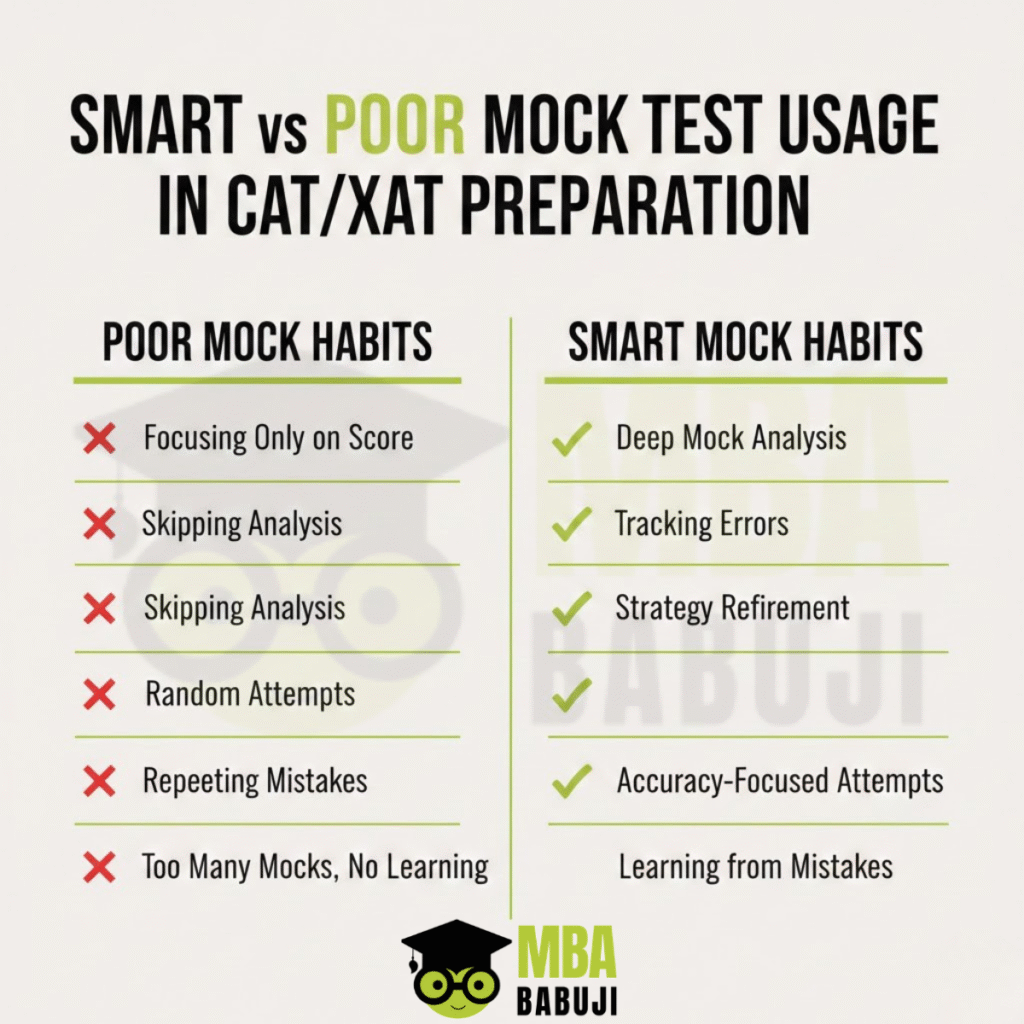
Most students approach mocks with the wrong mindset:
- Treating mocks as score contests rather than learning tools
- Focusing only on total marks instead of sectional performance
- Skipping deep analysis because it feels time-consuming
- Repeating the same mistakes due to a lack of tracking
- Taking too many mocks without improving fundamentals
As a result, mock scores stagnate — not because students lack ability, but because they fail to extract insights from their performance.
The Real Purpose of Mock Tests in MBA Entrance Exams
Mock tests serve three critical purposes:
1. Exam Simulation
Mocks train you to handle real exam pressure, time limits, and transitions between sections.
2. Strategy Testing
They help determine:
- Ideal attempt strategy
- Time allocation per section
- Question selection approach
3. Performance Diagnosis
Mocks reveal:
- Weak topics
- Accuracy issues
- Speed problems
- Repeated mistake patterns
When mocks are treated as feedback systems rather than judgment tools, improvement becomes measurable.
The Smartest Mock Strategy: Before, During, and After
Phase 1: Before the Mock — Set a Purpose
Never take a mock casually. Define a goal:
- Test time management
- Improve accuracy
- Experiment with the attempt strategy
- Reduce negative marking
A purpose-driven mock leads to targeted learning, not random effort.
Phase 2: During the Mock — Focus on Strategy, Not Ego
During the test:
- Avoid attempting every question
- Skip time-consuming problems
- Prioritize accuracy over reckless attempts
- Track time spent per section
- Practice calm decision-making under pressure
Smart aspirants aim for efficient scoring, not maximum question attempts.
Phase 3: After the Mock — Analysis Matters More Than the Score
The biggest improvement comes after the mock.
Spend 2–3 hours analyzing every test:
- Review wrong answers
- Identify guessed questions
- Check slow questions
- Evaluate better solution methods
- Note strategic errors
Mock analysis transforms mistakes into learning assets.
How to Analyze Mock Tests the Right Way

1. Categorize Errors
Classify mistakes as:
- Conceptual errors
- Calculation errors
- Time-management errors
- Guessing errors
2. Track Accuracy Trends
Monitor:
- Section-wise accuracy
- Topic-wise accuracy
- Guess vs confident answer ratio
3. Review Skipped Questions
Check whether skipped questions were actually solvable with a better strategy.
4. Build a Mistake Log
Maintain a simple log:
- Question type
- Error reason
- Correct approach
- Lesson learned
This prevents repeating the same mistakes.
How Smart Mock Usage Prevents Score Stagnation
Mock stagnation happens when:
- Analysis is shallow
- Mistakes are ignored
- Strategy remains unchanged
- Weak areas are avoided
Smart mock usage helps by:
- Gradually increasing accuracy
- Improving time efficiency
- Refining the attempt strategy
- Strengthening weak sections
- Building exam temperament
Improvement becomes progressive rather than accidental.
Realistic Examples of Poor vs Smart Mock Usage
Inefficient Approach
A student takes 10 mocks in a month, checks only the final score, and moves on. After months, the percentile remains unchanged.
Smart Approach
Another student takes 5 mocks but spends more time analyzing than attempting. They track mistakes, refine strategy, and steadily improve accuracy and speed.
Quality of analysis matters more than quantity of mocks.
What Toppers Do Differently With Mock Tests
Toppers treat mocks as strategy labs, not performance tests.
They:
- Analyze every mock deeply
- Track weak areas systematically
- Experiment with attempt strategies
- Maintain an error journal
- Focus on improvement metrics rather than raw scores
- Adjust their plan every month based on data
Their success comes from learning more from each mock, not from taking more mocks.
Practical Action Steps to Use Mocks Smartly
1. Limit Mocks, Increase Analysis
Take fewer mocks but analyze each one deeply.
2. Fix One Problem at a Time
After every mock, focus on improving one or two specific weaknesses.
3. Track Performance Metrics
Monitor:
- Accuracy
- Time per question
- Section-wise scores
- Improvement trends
4. Simulate Real Exam Conditions
Always attempt mocks in a timed, distraction-free environment.
5. Adjust Strategy Monthly
Revise attempt plans based on mock performance rather than assumptions.

Conclusion: Mock Tests Should Train Strategy, Not Stress
Mock tests are not meant to judge intelligence. They are meant to train strategy, improve discipline, and reveal performance gaps.
The smartest way to use mocks is not to take more, but to learn more from each one.
When mock tests are paired with structured analysis and strategy refinement, score improvement becomes predictable rather than uncertain.
FAQs
1. How many mock tests should I take for CAT/XAT/CET?
There is no fixed number. Focus on quality analysis rather than quantity. Even 1–2 mocks per week can be effective if reviewed properly.
2. Why is my mock score not improving despite practice?
Most likely because mistakes are not being analyzed deeply, or the strategy is not evolving.
3. How much time should I spend analyzing a mock?
Ideally, 2–3 hours per mock — more than the time spent attempting it.
4. Should I retake the mock questions I got wrong?
Yes. Revisiting mistakes helps reinforce correct methods and prevents repetition.