
Busy vs Productive: The Mindset Difference in CAT Preparation
Focus: Study quality, daily decision habits, avoiding fake progress
Introduction: Why “Studying All Day” Is Not Helping Many CAT Aspirants
Many CAT aspirants follow a similar daily routine.
They wake up early, attend classes, solve questions, watch concept videos, and end the day feeling exhausted but satisfied.
Yet after weeks of effort, mock scores remain stuck.
This creates confusion:
“I’m studying seriously. Why am I not improving?”
The answer is uncomfortable but important.
Most aspirants are busy, not productive.
In CAT preparation, progress does not depend on how full your day looks, but on how well your study decisions are aligned with score improvement.
What Most Aspirants Mean by “Being Busy”
Being busy usually looks like this:
- Studying for long hours
- Solving many questions daily
- Watching multiple lectures
- Taking mocks regularly
- Constantly switching topics
On paper, everything seems right.
In reality, much of this effort produces very little measurable improvement.
👉 The problem is not effort.
👉 The problem is how that effort is directed.
What Being Productive Actually Means in CAT Preparation
Productivity in CAT prep is outcome-oriented, not activity-oriented.
A productive aspirant focuses on:
- Improving accuracy
- Reducing repeat mistakes
- Increasing score consistency
- Making better decisions in mocks
A productive day is not one where you did more, but one where you fixed something specific.
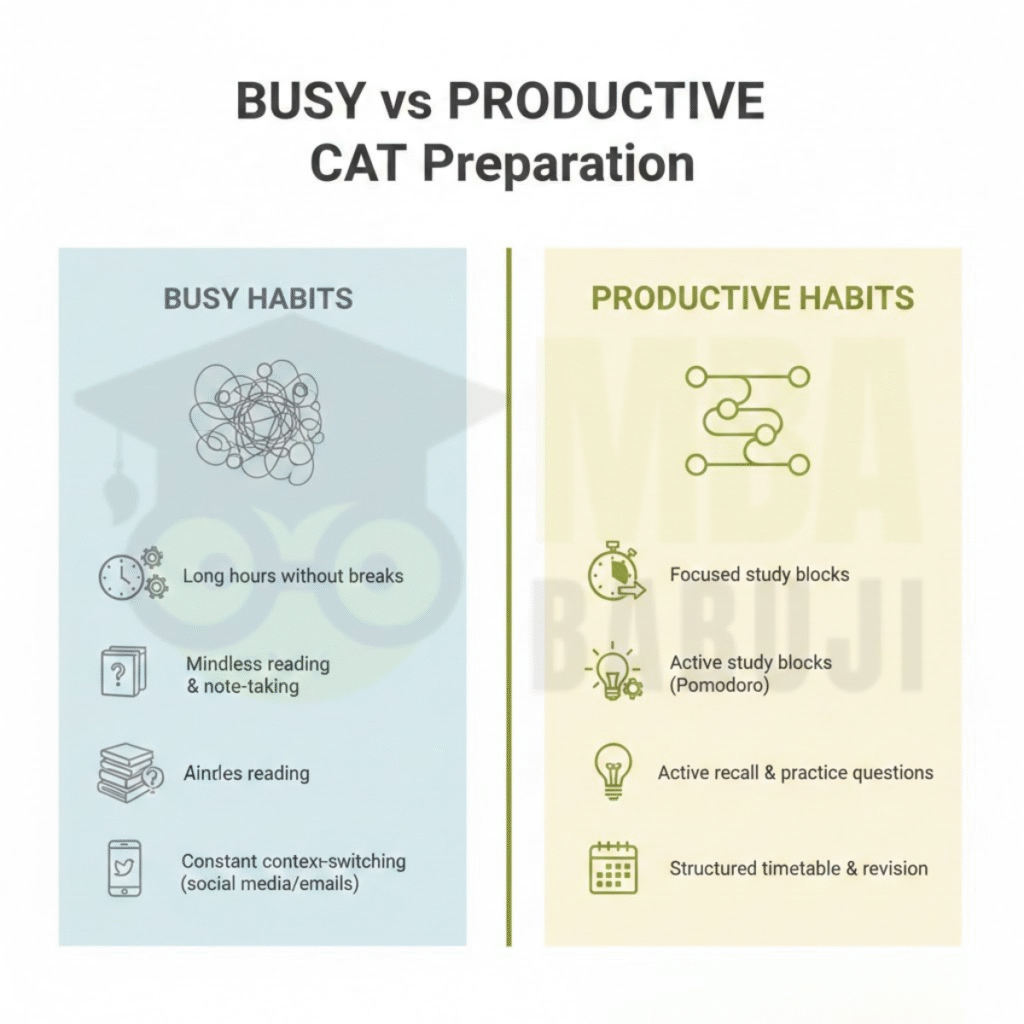
The Core Difference: Activity vs Impact
| Busy Preparation | Productive Preparation |
|---|---|
| Long study hours | Focused study blocks |
| Random question solving | Targeted practice |
| More mocks | Better mock analysis |
| Feeling “worked hard” | Seeing score movement |
| Repeating same mistakes | Eliminating mistakes |
Many aspirants confuse effort with effectiveness. CAT does not reward effort — it rewards decision quality.
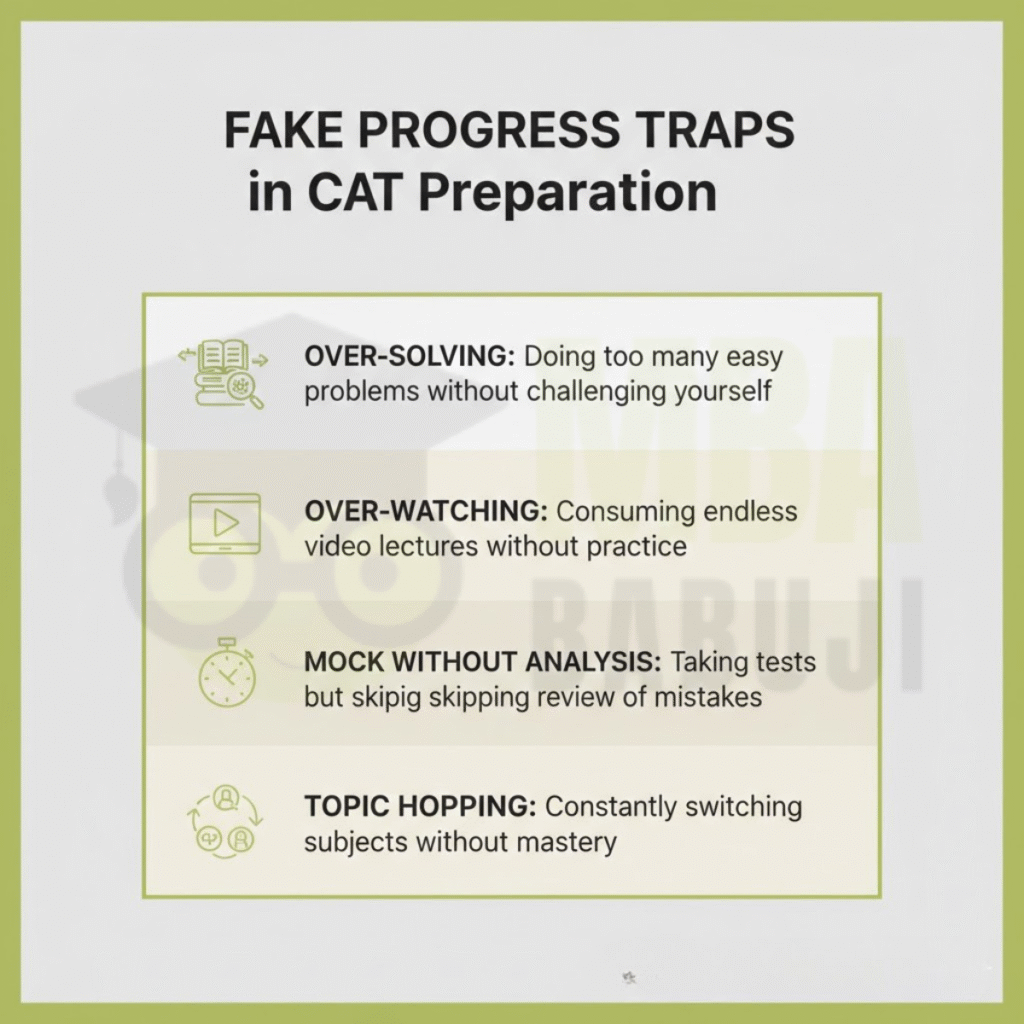
Most Common “Fake Progress” Traps
1. Solving Questions Without Learning
Solving 50 questions feels productive.
But if the same mistake appears again tomorrow, nothing has improved.
2. Watching Concept Videos Repeatedly
Rewatching lectures creates comfort, not competence.
Understanding is proven only through application under time pressure.
3. Taking Mocks Without Proper Analysis
Mocks without analysis only reinforce bad habits.
Improvement comes from post-mock decisions, not the mock itself.
4. Switching Topics Too Often
Jumping between topics creates the illusion of coverage, not mastery.
How Daily Decision Habits Shape CAT Outcomes
CAT preparation is a decision-making exercise spread over months.
Every day you decide:
- What to study
- What to revise
- What to ignore
- How much time to spend
- When to stop and analyze
Busy aspirants make decisions based on:
- Mood
- Motivation
- Fear of missing out
Productive aspirants make decisions based on:
- Performance data
- Error patterns
- ROI of topics
How Toppers Stay Productive Without Studying All Day
Toppers are rarely the ones studying the longest hours.
They are the ones who control their preparation tightly.
What Toppers Do Differently
- Practice fewer questions, but analyze deeply
- Track accuracy and time per question
- Maintain an error log
- Revise weak areas repeatedly
- Protect focus hours
They aim to remove inefficiency, not add more work.
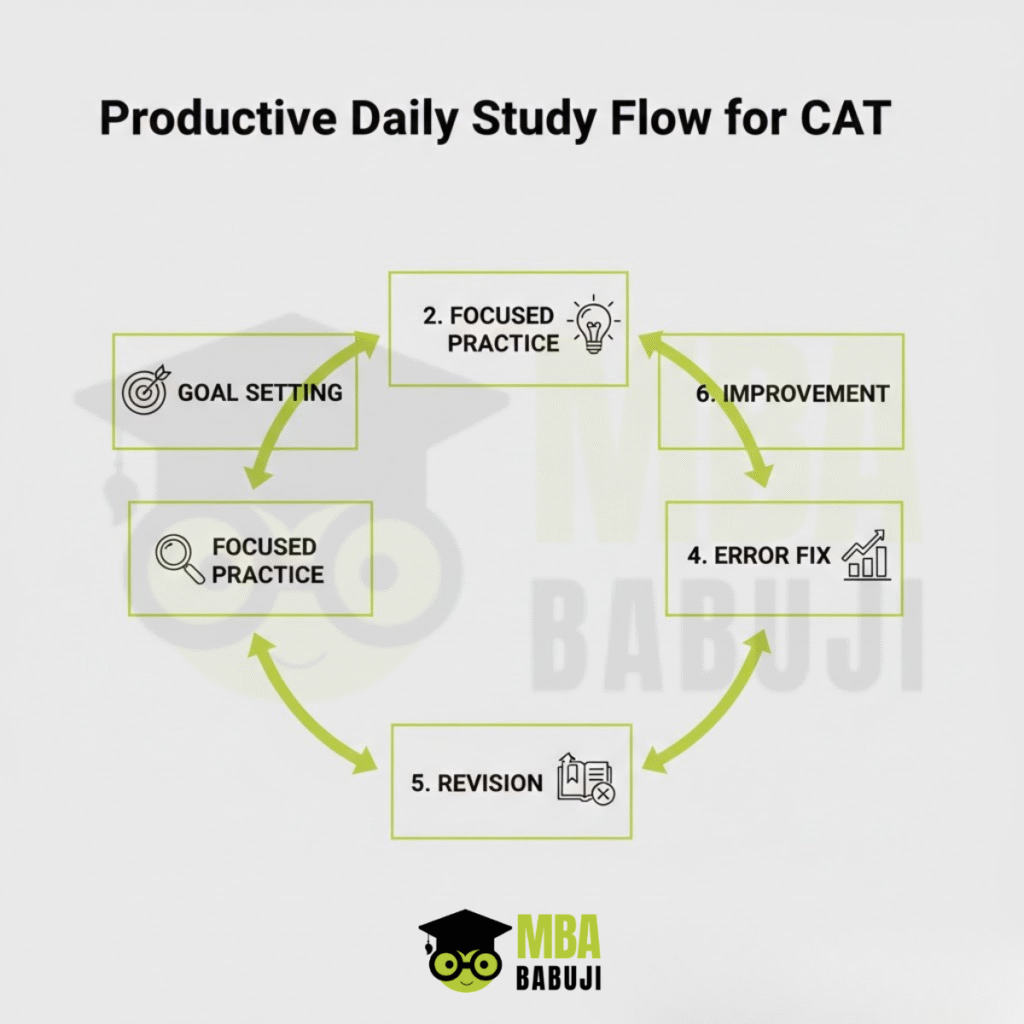
Turning Busy Study into Productive Study
Step 1: Define the Purpose of Every Study Session
Before starting, ask:
What exactly am I trying to improve today?
Examples:
- Accuracy in arithmetic
- Speed in RC
- Set selection in DILR
No purpose = low productivity.
Step 2: Measure Output, Not Time
Replace this question:
“How many hours did I study?”
With:
“What changed because I studied?”
Did accuracy improve?
Did a mistake reduce?
Did time per question drop?
Step 3: Limit Daily Targets
Too many tasks reduce depth.
Productive days have limited, clear goals.
Example:
- 20 quant questions + full analysis
- 1 RC passage + error review
- Revision of mock mistakes
Step 4: Build a Fixed Analysis Habit
Analysis should be non-negotiable, not optional.
If you skip analysis, you are choosing to stay busy rather than be productive.
How This Mindset Reflects in Mock Scores
Busy aspirants:
- Fluctuating scores
- Same errors repeating
- Emotional response to bad mocks
Productive aspirants:
- Gradual score stability
- Fewer silly mistakes
- Better control during exams
CAT rewards control and clarity, not panic and overload.
Conclusion: CAT Success Comes From Smart Daily Decisions
CAT preparation is not about doing more.
It is about doing the right things repeatedly.
If your preparation feels heavy but your scores feel light, pause and reflect.
Ask yourself:
Am I busy… or am I productive?
Once you shift this mindset, improvement becomes predictable, not accidental.
FAQs
1. How can I tell if my CAT preparation is busy or productive?
If your mock scores and accuracy are not improving despite regular study, your preparation is busy, not productive.
2. Is studying long hours bad for CAT preparation?
Long hours are not bad, but unfocused long hours without analysis usually lead to burnout and stagnation.
3. How many hours do productive CAT aspirants study daily?
Most productive aspirants study 4–6 focused hours, with clear goals and analysis.
4. What is the biggest sign of fake progress in CAT prep?
Repeating the same mistakes across mocks despite regular practice.