
The Cost of Overconfidence in CAT Mocks: Why Scores Stop Improving
If you have been giving CAT mocks regularly, you already know one reality:
Mocks can make or break your final percentile.
But there is one silent problem that many serious aspirants don’t notice early enough — overconfidence.
Not the “I will crack the CAT easily” type of overconfidence.
The more dangerous one is the daily version:
- “This section was easy, I don’t need analysis.”
- “I know why I got it wrong.”
- “I can improve later.”
- “Next mock will be better.”
This habit looks harmless. In fact, it often feels like confidence.
But over time, it becomes the biggest reason behind score stagnation in CAT mocks.
This article explains the real cost of overconfidence, how it ruins mock improvement, and what to do instead — in a practical, mentor-like way.
What Most Aspirants Think Overconfidence Means (And Why That’s Not the Real Issue)
When students hear “overconfidence”, they imagine someone who:
- Brags about scores
- Doesn’t study
- Thinks CAT is easy
- Takes mocks casually
But the overconfidence that harms CAT preparation is usually seen in serious aspirants.
It appears when a student is:
- Taking mocks regularly
- Studying daily
- Solving practice questions
- Watching strategy videos
- Doing sectional tests
Yet their scores remain stuck in the same range.
Because the overconfidence is not in effort — it is in assumptions.
The Real Meaning of Overconfidence in CAT Mocks
In CAT preparation, overconfidence usually looks like this:
1) Believing Your Mock Performance Reflects Your Real Ability
Many students think:
“My mock score is low because of silly mistakes. Otherwise I’m good.”
Sometimes it’s true. But when this becomes your default explanation, you stop improving.
Because your brain stops treating errors seriously.
2) Skipping Deep Mock Analysis Because You “Already Know.”
This is the biggest sign.
Students often say:
- “I know where I went wrong.”
- “I’ll correct it next time.”
- “No need to spend 2 hours analyzing.”
But CAT improvement does not come from knowing mistakes.
It comes from tracking patterns and fixing them systematically.
3) Thinking One Great Mock Means You’ve Cracked the Strategy
A sudden jump in score can be motivating.
But many aspirants treat it as proof:
“Now my strategy is correct.”
They stop experimenting, stop questioning, and stop improving.
Then the next mock goes down again — and confusion starts.
Why Overconfidence Feels Productive (But Is Actually Dangerous)
Overconfidence is attractive because it protects your ego.
Mock analysis is uncomfortable because it forces you to accept:
- Your decision-making was weak
- Your question selection was poor
- Your time management was wrong
- Your accuracy is not stable
- Your speed is not reliable under pressure
Instead of facing this, the mind chooses a shortcut:
“It was just a bad day.”
Overconfidence reduces pain in the short term.
But it increases stagnation in the long term.
The Real Cost of Overconfidence in CAT Mocks
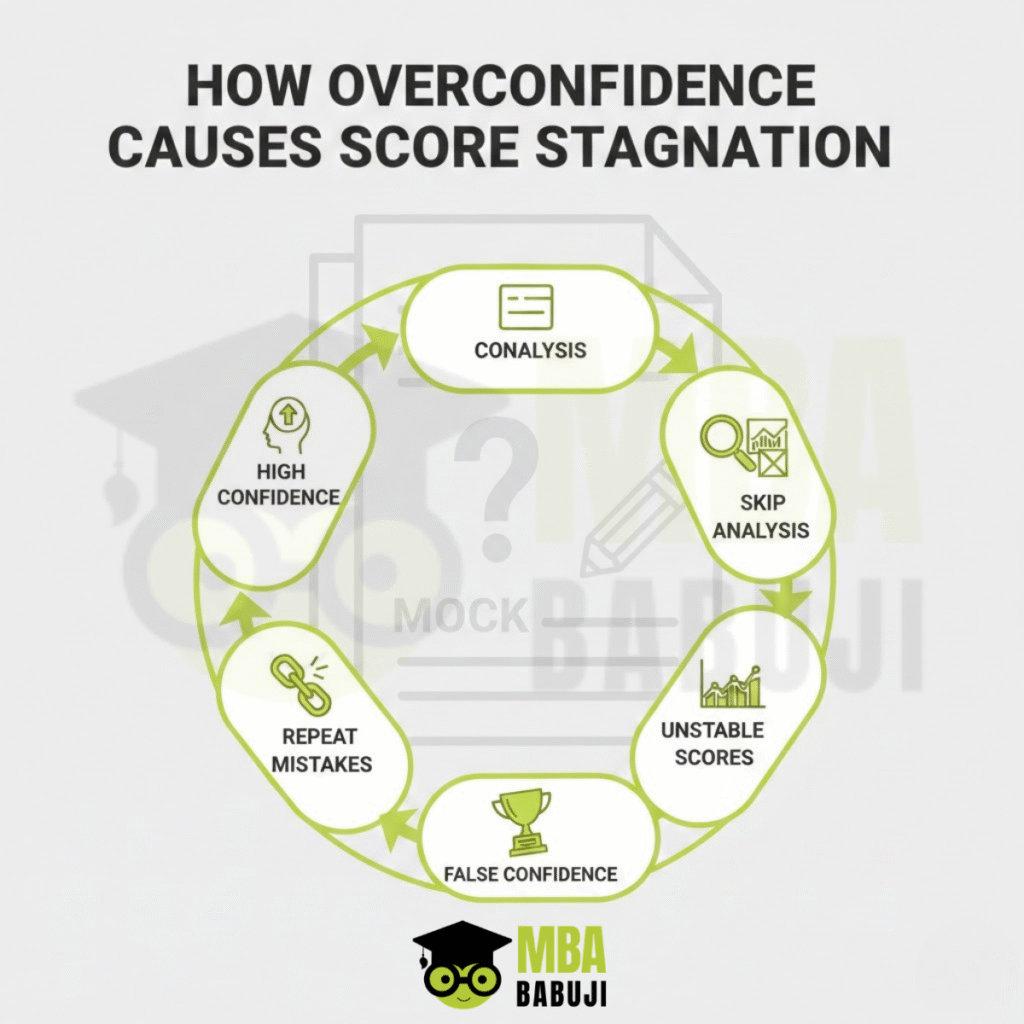
Let’s break down what you actually lose when you become overconfident.
1) You Repeat the Same Mistakes for Weeks
This is the most common pattern.
You might be making the same error again and again:
- Misreading RC tone questions
- Getting trapped in lengthy DI sets
- Over-attempting QA
- Spending 4 minutes on one algebra question
- Guessing in VARC under pressure
But since you don’t track mistakes properly, you keep repeating them.
2) Your Accuracy Stops Improving
Accuracy is not built by solving more questions.
Accuracy improves when you understand:
- Why you made the mistake
- What type of mistake it was
- How to prevent it next time
Overconfidence makes you ignore this step.
So accuracy remains stuck at 60–70%, which is dangerous in CAT.
3) Your Mock Scores Become Unstable
A student stuck due to overconfidence usually has mock scores like:
- 45
- 62
- 48
- 70
- 50
This instability is not random.
It happens because you are not building consistency.
Mocks are supposed to help you stabilize your process.
4) You Lose the Biggest Advantage of Mocks: Learning
A mock is not only a test. It is a learning tool.
If you treat it as a performance measure only, you lose its value.
Mocks should give you:
- clarity about strengths and weaknesses
- improvement in selection skills
- better timing decisions
- section-wise stability
- confidence based on data
Overconfidence blocks all of this.
5) Your Confidence Becomes Fake Confidence
This is the most dangerous cost.
Real confidence in CAT comes from:
- consistent performance
- predictable accuracy
- repeatable strategy
- strong decision-making
Overconfidence gives you temporary comfort, but it collapses under pressure.
Then, on exam day, even strong students panic.
Where Overconfidence Shows Up in CAT Sections
Overconfidence is not the same in every section.
VARC (Verbal Ability & Reading Comprehension)
Overconfidence appears as:
- “VARC is unpredictable anyway.”
- “I will improve naturally by reading.”
- “I don’t need to analyze RC errors.”
Result:
- Same question types remain weak
- Accuracy fluctuates heavily
- Wrong attempts increase
DILR (Data Interpretation & Logical Reasoning)
Overconfidence appears as:
- Attempting a tough set just to prove you can
- Not leaving a set early
- Believing “I almost solved it” means progress
Result:
- You waste 12–15 minutes
- You miss easy sets
- You end up with 1.5 sets instead of 2.5 sets
QA (Quantitative Aptitude)
Overconfidence appears as:
- Over-attempting questions
- Not respecting time limits
- Assuming you can solve it if you try longer
Result:
- Time goes to 2–3 hard questions
- Easy questions remain unattempted
- Accuracy drops
Realistic Examples of Overconfidence in CAT Mocks
Let’s look at common situations.
Example 1: “I Scored 75 Once, So I’m Set”
A student gets one good mock score due to:
- easy mock
- lucky question selection
- familiar topics
- strong VARC day
Then they relax.
Next 3 mocks drop to 50–55, and they feel lost.
Example 2: “My Mistakes Are Silly, Not Conceptual”
Many aspirants keep saying this.
But after 10 mocks, if mistakes are still “silly”, it means:
- You don’t have a prevention system
- Your attention control is weak
- Your exam temperament needs training
Silly mistakes are not small. They are repeated penalties.
Example 3: “I Don’t Have Time for Analysis”
This is the biggest lie students tell themselves.
If you are giving 2 mocks a week and not analyzing them properly, you are wasting:
- 4 hours in mock attempt
- 0 improvement in learning
- 2–3 days of false confidence
Mock analysis is not extra work.
It is the main work.
Why Score Stagnation Happens Due to Overconfidence
Overconfidence creates a loop:
- You attempt a mock
- You can check your score quickly
- You feel happy or disappointed
- You assume reasons
- You move to the next mock
- You repeat mistakes
- Scores remain stuck
This is why many aspirants take 20–30 mocks but show almost no percentile growth.
They are testing themselves repeatedly, not training themselves.
What Toppers Do Differently (That Average Aspirants Don’t)
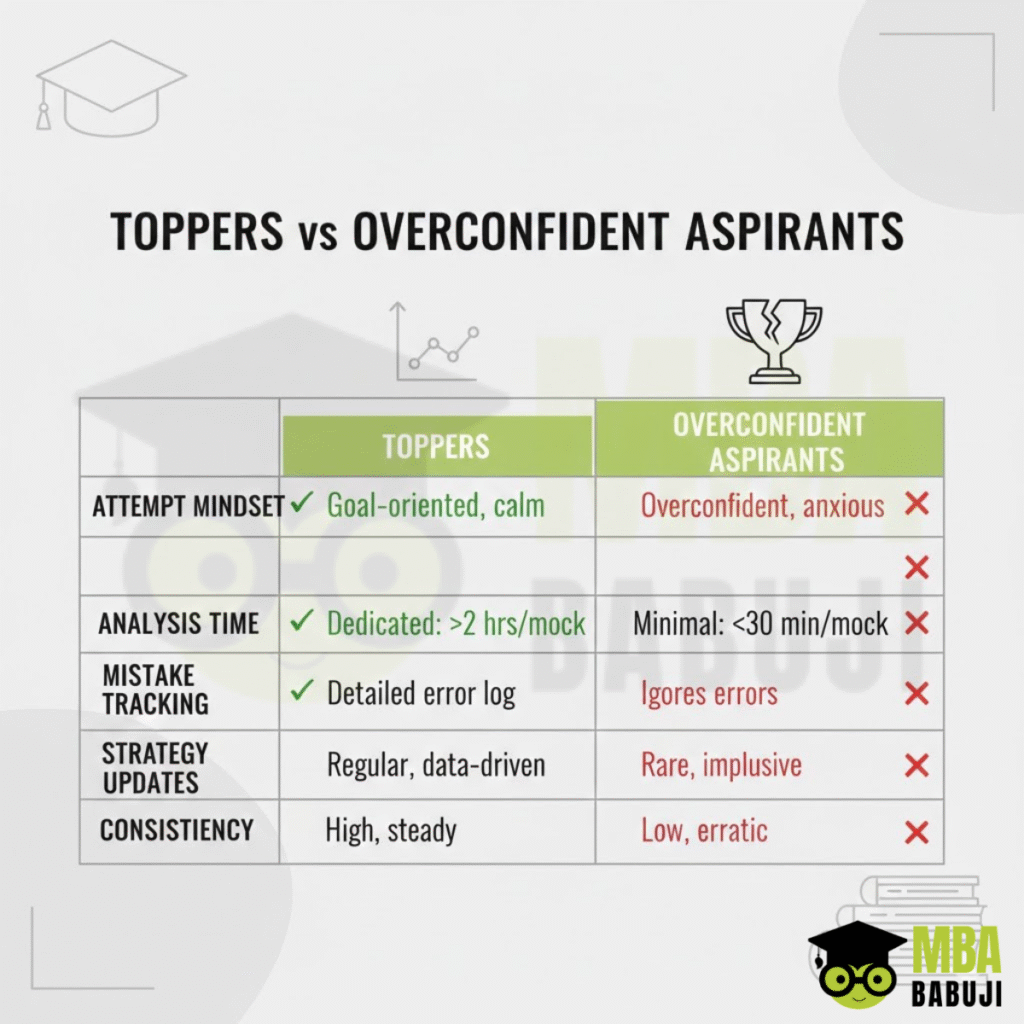
Toppers are not perfect.
But their mock routine has one big difference:
They treat every mock like a data report.
They focus on:
- Which question types are weak
- Why was time wasted
- Where wrong decisions happened
- Which topics are scoring
- What strategy needs change
They don’t just “give mocks”.
They extract insights from mocks.
That is why their score improves steadily.
How to Fix Overconfidence in CAT Mocks (Practical Steps)
You don’t need motivation. You need a system.
Here are realistic steps that work.
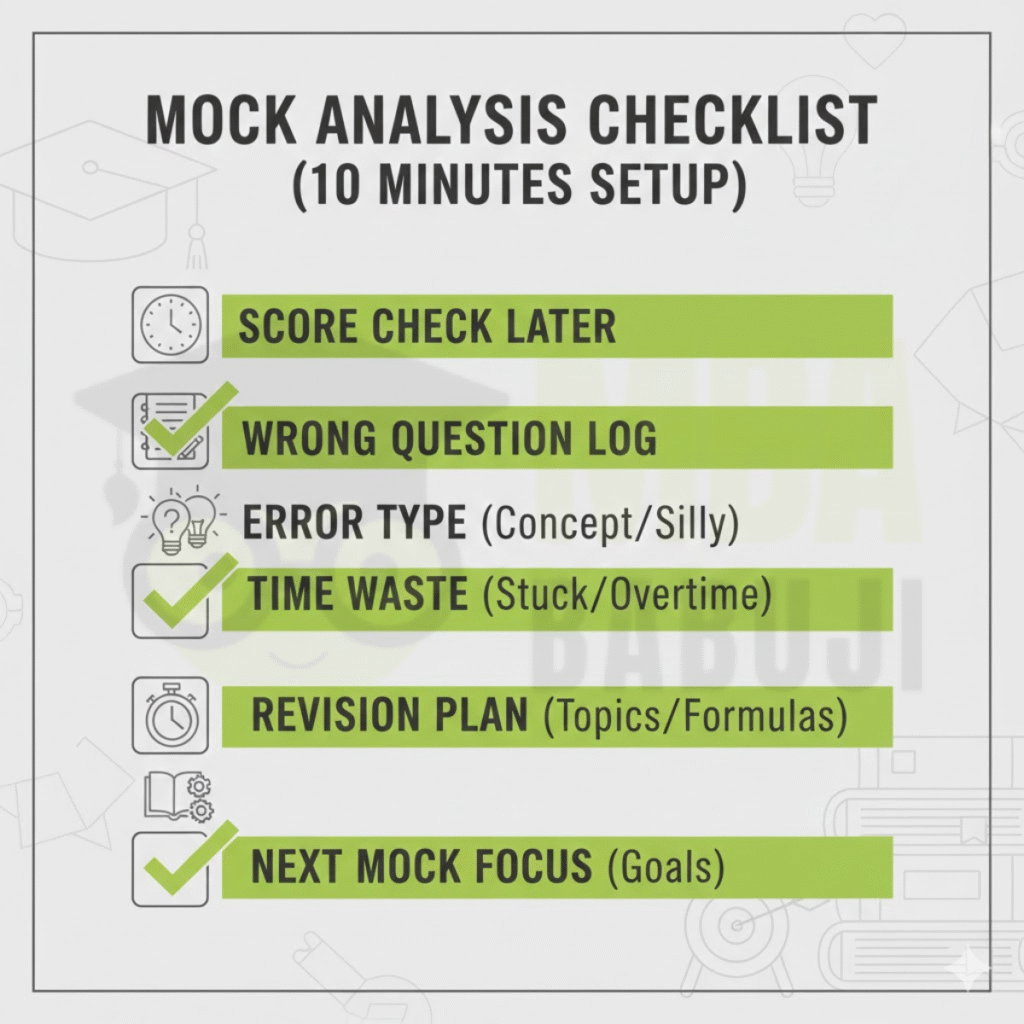
Step 1: Replace “I Know My Mistake” With Written Proof
After every mock, write down:
- 5 wrong questions
- Why wrong
- What mistake type
- What will you do differently
This simple habit kills overconfidence immediately.
Because it forces clarity.
Step 2: Categorize Mistakes Into 4 Buckets
For each wrong or skipped question, mark:
- Concept gap
- Logic gap (DILR selection/approach)
- Time management error
- Carelessness/reading error
Most students don’t improve because they don’t know which bucket dominates.
Step 3: Track 3 Metrics Only (Don’t Overcomplicate)
You only need:
- Attempt count per section
- Accuracy % per section
- Time wasted zones (where you spent too long)
If these 3 improve, your percentile improves.
Step 4: Fix One Habit Per Week, Not Everything Together
Overconfidence often comes from trying to “solve everything” mentally.
Instead:
- Week 1: Improve DILR set selection
- Week 2: Reduce QA time per question
- Week 3: Improve VARC accuracy
- Week 4: Improve mock stability
One improvement at a time is realistic and measurable.
Step 5: Use the “15-Minute Rule” for Hard Questions
This works especially for DILR and QA.
If you spend:
- 3 minutes and no progress in QA → skip
- 7 minutes and no breakthrough in DILR set → leave
Overconfidence makes you stay longer.
Discipline makes you move on.
Step 6: Stop Treating High Scores as Validation
A high mock score is not a certificate.
Ask:
- Was accuracy high or luck-based?
- Did I attempt too much?
- Was the paper easy?
- Was the strategy repeatable?
This mindset prevents fake confidence.
A Balanced Mock Mindset That Actually Works
The best CAT mock mindset is:
- confident but not casual
- serious but not emotional
- analytical but not overthinking
- consistent but flexible
Mocks are not meant to make you feel good.
They are meant to make you better.
Conclusion: Confidence Is Useful Only When It Comes From Analysis
Overconfidence in CAT mocks is not about attitude.
It is about skipping the boring, uncomfortable part of preparation:
analysis, reflection, and correction.
If you want real improvement, remember this:
- CAT rewards decision-making, not hard work alone
- Mocks reward analysis, not mock count
- Percentile growth comes from fixing patterns, not solving random questions
The moment you start treating mocks like data, your scores will stop stagnating.
FAQs
1) How many CAT mocks are enough if I analyze properly?
Quality matters more than quantity. Even 15–20 well-analyzed mocks can improve the percentile more than 40 poorly analyzed mocks.
2) What is the biggest sign of overconfidence in CAT preparation?
The biggest sign is skipping mock analysis and assuming you already understand your mistakes.
3) How long should the CAT mock analysis take?
For a 2-hour mock, 2 to 3 hours of analysis is ideal if you want real improvement.
4) My scores fluctuate a lot. Is it due to overconfidence?
Often yes. Score instability usually means your strategy is not consistent and your mistakes are repeating without correction.