
The First 30 Minutes of CAT Decide Your Percentile: Here’s Why Toppers Never Waste Them
Most CAT aspirants believe that the exam is a test of endurance — that surviving all 120 minutes matters more than how you start. CAT toppers think very differently.
For them, the first 30 minutes are not a warm-up phase. They are the foundation on which the final percentile is built.
This opening window decides your confidence, accuracy, and mental rhythm. A poor beginning forces recovery mode. A strong beginning quietly compounds marks without panic.
Let’s break down why the first 30 minutes matter so much and how top scorers use them to their advantage.
Why the First 30 Minutes Matter More Than You Think

1. Your Accuracy Is Highest at the Start
At the beginning of the exam:
- Your mind is fresh
- Cognitive fatigue hasn’t set in
- Logical reasoning is sharper
This is when careless errors are least likely. Toppers prioritize accuracy early instead of chasing volume.
One wrong decision here doesn’t just cost marks — it damages confidence.
2. Early Panic Has a Domino Effect
A rushed or aggressive start leads to:
- Early negative marking
- Increased anxiety
- Overcompensation later in the section
Once panic enters, aspirants start “chasing lost marks” — the most dangerous CAT habit.
Toppers avoid this entirely by keeping the first 30 minutes controlled, predictable, and low-risk.
3. CAT Rewards Question Selection, Not Speed
CAT is not about solving the maximum number of questions. It is about:
- Identifying easy-to-moderate questions
- Skipping traps without ego
- Preserving time for high-conversion attempts
The first 30 minutes are used to scan, shortlist, and lock safe attempts, not to prove intelligence.
How CAT Toppers Actually Use the First 30 Minutes
Step 1: Smart Scanning, Not Random Solving
In the opening minutes, toppers:
- Quickly scan all questions
- Mentally tag questions as easy, uncertain, or skip
- Ignore intimidating or calculation-heavy problems
They don’t get emotionally attached to questions.
Step 2: Lock Guaranteed Marks First
Toppers focus on:
- Familiar patterns
- Straightforward logic
- High-confidence questions
These early marks act as a psychological buffer for tougher questions later.
Step 3: Time Discipline Over Ego
No topper forces a question to work.
If a problem doesn’t click within a reasonable time:
- They move on
- No frustration
- No second-guessing
This discipline in the first 30 minutes saves massive time and mental energy.
Section-Wise First 30 Minutes Strategy
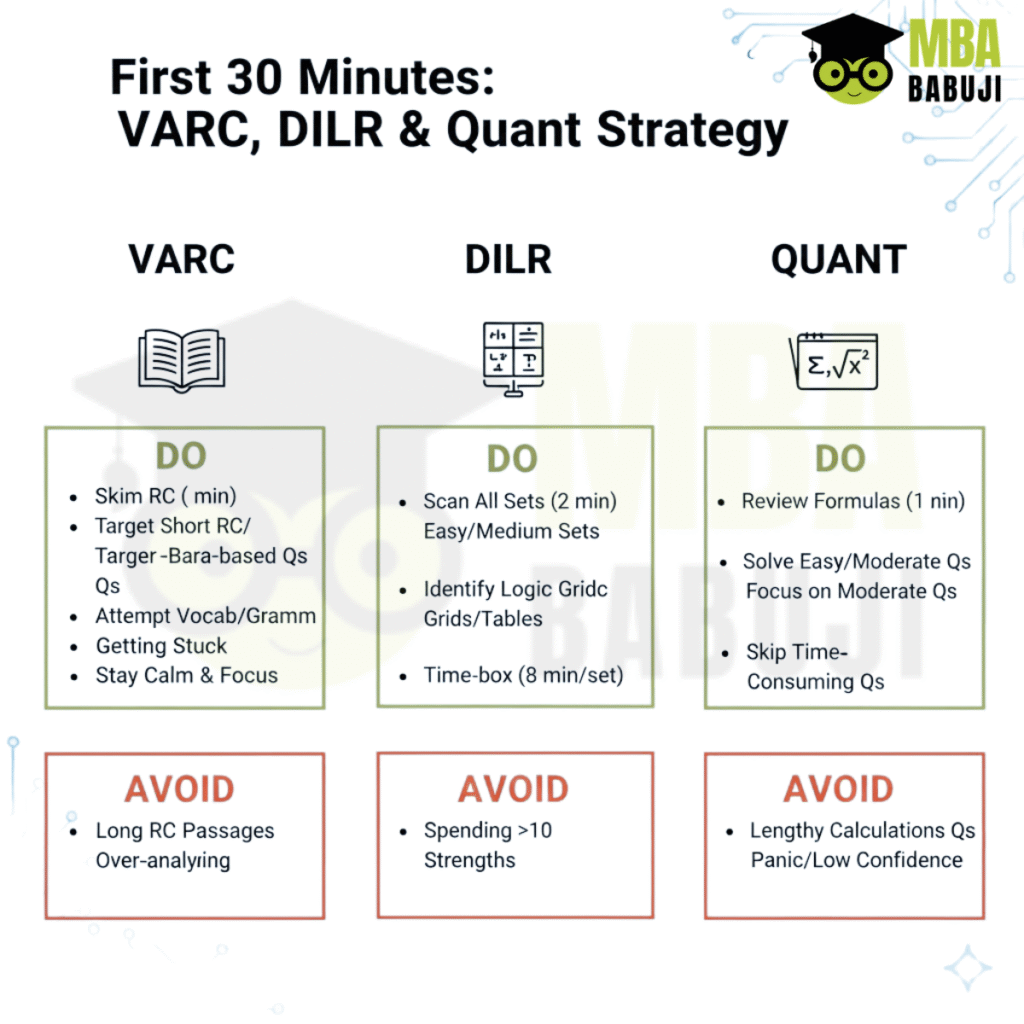
VARC
- Start with passages that feel readable, not famous
- Avoid dense philosophy or abstract RCs initially
- Prioritize VA questions with clear logic
Goal: Build momentum, not mastery
DILR
- Scan all sets first
- Choose the most structured, data-light set
- Ignore sets with too many assumptions early
Goal: Solve one clean set perfectly
Quant
- Attempt sitters and formula-based questions first
- Skip lengthy arithmetic traps
- Avoid “almost solvable” questions early
Goal: Accuracy over ambition
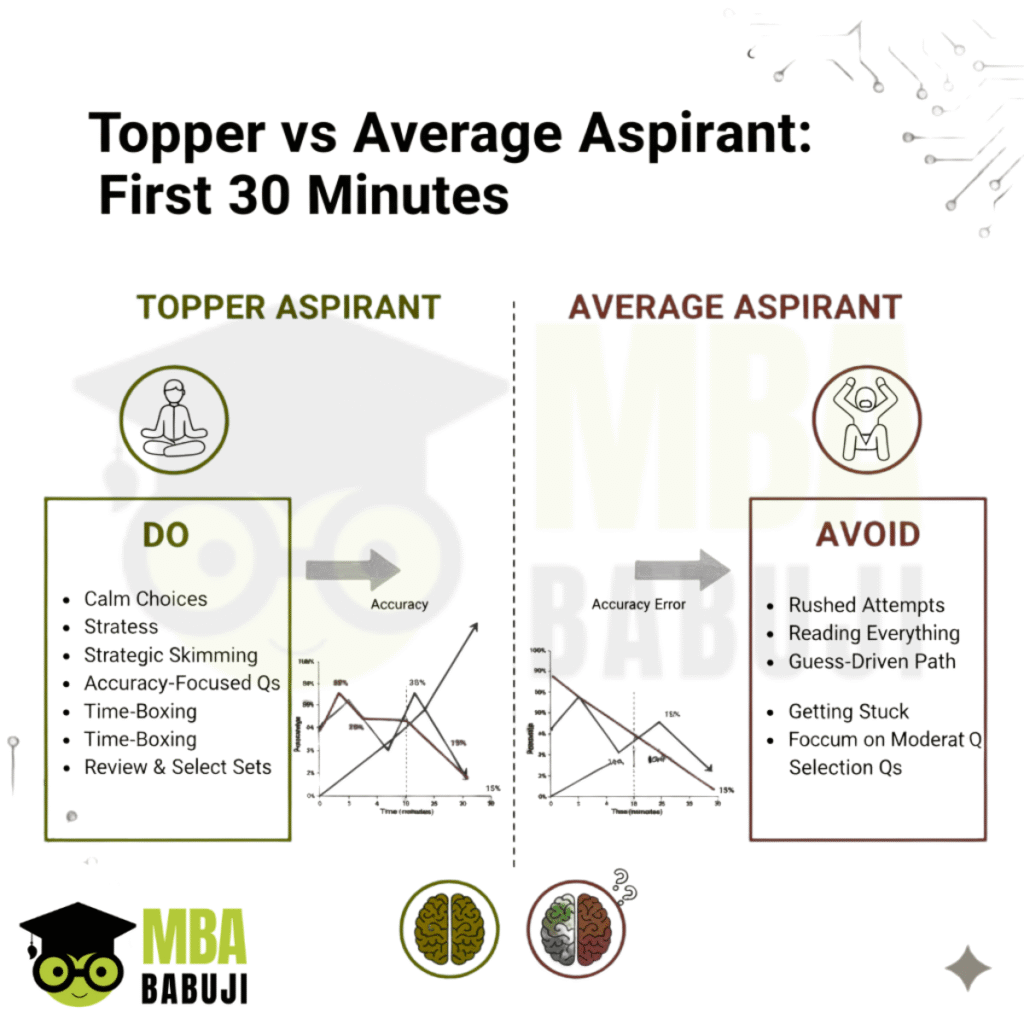
Why Most Aspirants Get the First 30 Minutes Wrong
Common mistakes include:
- Starting with the toughest-looking question
- Trying to solve everything sequentially
- Confusing confidence with aggression
- Treating skipping as failure
Toppers understand one truth:
Skipping is a strategy, not a weakness.
Final Takeaway
Your CAT percentile doesn’t collapse because you didn’t know enough concepts.
It collapses because your early decisions lacked control.
Master the first 30 minutes, and the remaining 90 become manageable — sometimes even comfortable.
CAT rewards calm thinkers, not rushed solvers.
FAQs
Q1. Should I attempt more questions in the first 30 minutes?
No. Focus on high-accuracy attempts, not volume.
Q2. Is skipping questions early risky?
Skipping early actually reduces risk by preventing negative marking and panic.
Q3. Should strategy differ for repeaters?
Repeaters benefit even more from disciplined starts, as overconfidence often causes early mistakes.
Q4. Can this strategy work for XAT, CET, and NMAT?
Yes. Controlled starts and smart selection apply across all MBA entrance exams.