
The Biggest Time-Wasting Habit in CAT, XAT & CET Preparation: The Hidden Reason Scores Don’t Improve
Introduction: The “Busy but Not Improving” Trap
Many CAT, XAT, CET, NMAT, and SNAP aspirants follow a strict daily routine. They study for hours, solve questions, watch concept videos, and attempt mocks. Yet, months later, their mock scores barely improve.
They often feel confused:
“I’m studying seriously. Why am I still stuck at the same score?”
In most cases, the issue is not intelligence, syllabus coverage, or effort. The real problem lies in a hidden daily habit that wastes time while giving the illusion of productivity.
This habit is not laziness. It is inefficient preparation behavior that quietly blocks real progress.
What Most Students Think Wastes Time (But Isn’t the Real Problem)
When scores don’t improve, students usually blame:
- Social media and phone distractions
- Laziness or lack of discipline
- Limited study hours
- Poor concepts or weak basics
While these can affect preparation, they are not the biggest daily time-waster for serious aspirants.
Many disciplined students with 5–7 hours of study time still stagnate.
The real issue is how time is used, not how much time is used.
The Biggest Time-Wasting Habit: Studying Without Structure or Feedback
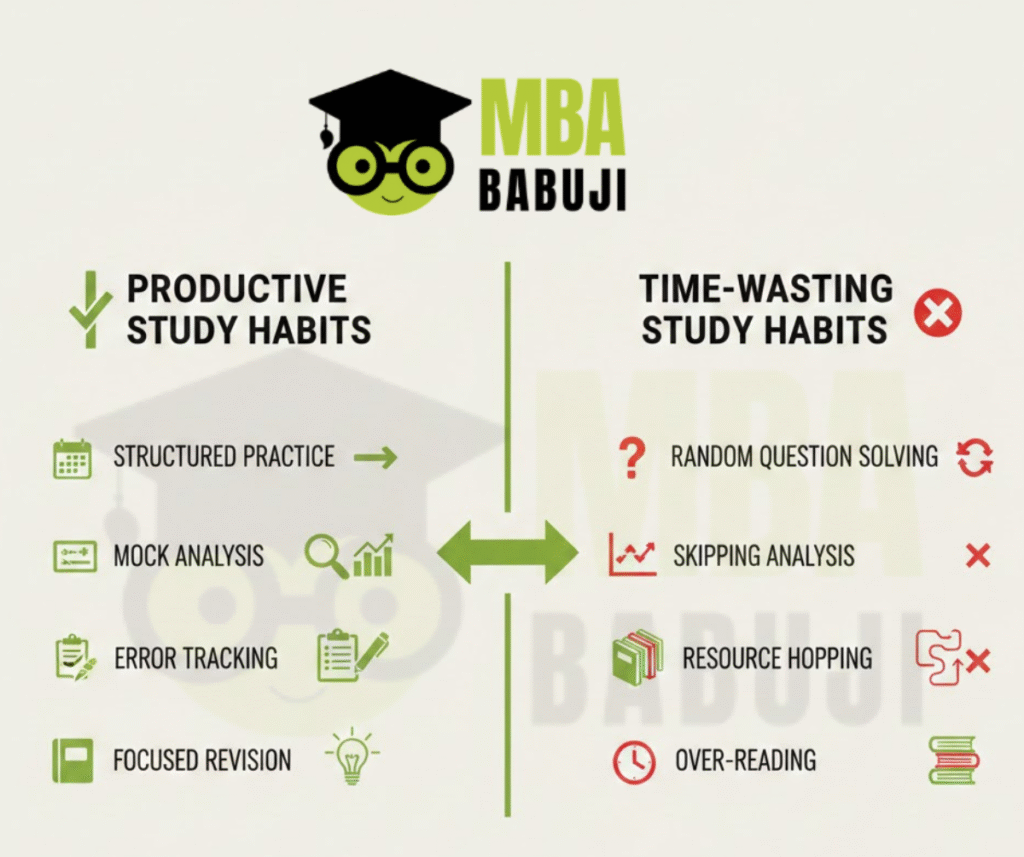
The single biggest time-wasting habit in CAT, XAT, and CET preparation is:
Doing large amounts of study and practice without structured strategy or proper analysis.
This includes behaviors such as:
- Solving random questions without a plan
- Over-studying concepts but under-practicing application
- Taking mock tests but skipping deep analysis
- Repeating mistakes without tracking them
- Jumping between resources instead of mastering one
- Feeling “busy” without measuring improvement
Why Students Fall Into This Habit
This habit develops because:
- Solving questions feels like real work
- Watching videos feels like learning
- Completing chapters feels productive
- Avoiding analysis feels easier than facing mistakes
It creates a sense of effort, even when learning remains shallow.
Why It Feels Productive
- You can count the hours studied
- You can count the questions solved
- You feel active and engaged
- You feel like you’re “doing enough.”
But progress in MBA entrance exams is not measured by effort — it is measured by accuracy, speed, and decision-making.
Why This Habit Silently Kills Progress
Unstructured preparation wastes time in subtle ways:
- Mistakes get repeated because they are never reviewed
- Weak areas remain weak despite hours of study
- Strengths are not optimized strategically
- Speed does not improve because practice lacks focus
- Mock scores stagnate due to a lack of learning from errors
Over time, this leads to plateaued percentiles and rising frustration.
Students feel tired, overworked, and demotivated — not because they are failing to study, but because they are studying without direction.
How This Habit Hurts CAT, XAT & CET Performance
1. Lower Accuracy
Solving many questions without analyzing errors leads to repeated conceptual and logical mistakes.
2. Slow Speed
Speed improves only through targeted, timed practice, not random question-solving.
3. Flat Mock Scores
Mocks become routine attempts instead of learning tools, resulting in stagnant scores.
4. Poor Sectional Balance
Time gets wasted on comfortable topics while weak sections remain ignored.
5. Weak Exam Strategy
Without reviewing mock attempts, students fail to develop question selection and time-management skills.
6. Reduced Confidence
Repeated low scores without visible improvement create self-doubt, even among capable students.
Realistic Daily Examples from Aspirants
Example 1: Six Hours, Zero Improvement
A student studies for six hours daily, finishes multiple chapters, but never revisits mistakes. After three months, accuracy remains unchanged.
Example 2: Solving 50 Questions Without Learning
Another aspirant solves 40–50 questions daily but moves on without analyzing why 15–20 answers were wrong.
Example 3: Mock Tests Without Review
A student takes two mocks every week but spends only 20 minutes reviewing instead of 2–3 hours understanding errors.
Example 4: Resource Switching
Instead of mastering one material, a student keeps changing books, courses, and teachers — losing depth and continuity.
Example 5: Repeating the Same Mistakes
Because errors are not tracked, the same calculation mistakes, logic errors, or comprehension traps occur again and again.
These students are not lazy. They are simply misusing effort.
What Toppers Do Differently in Their Daily Routine
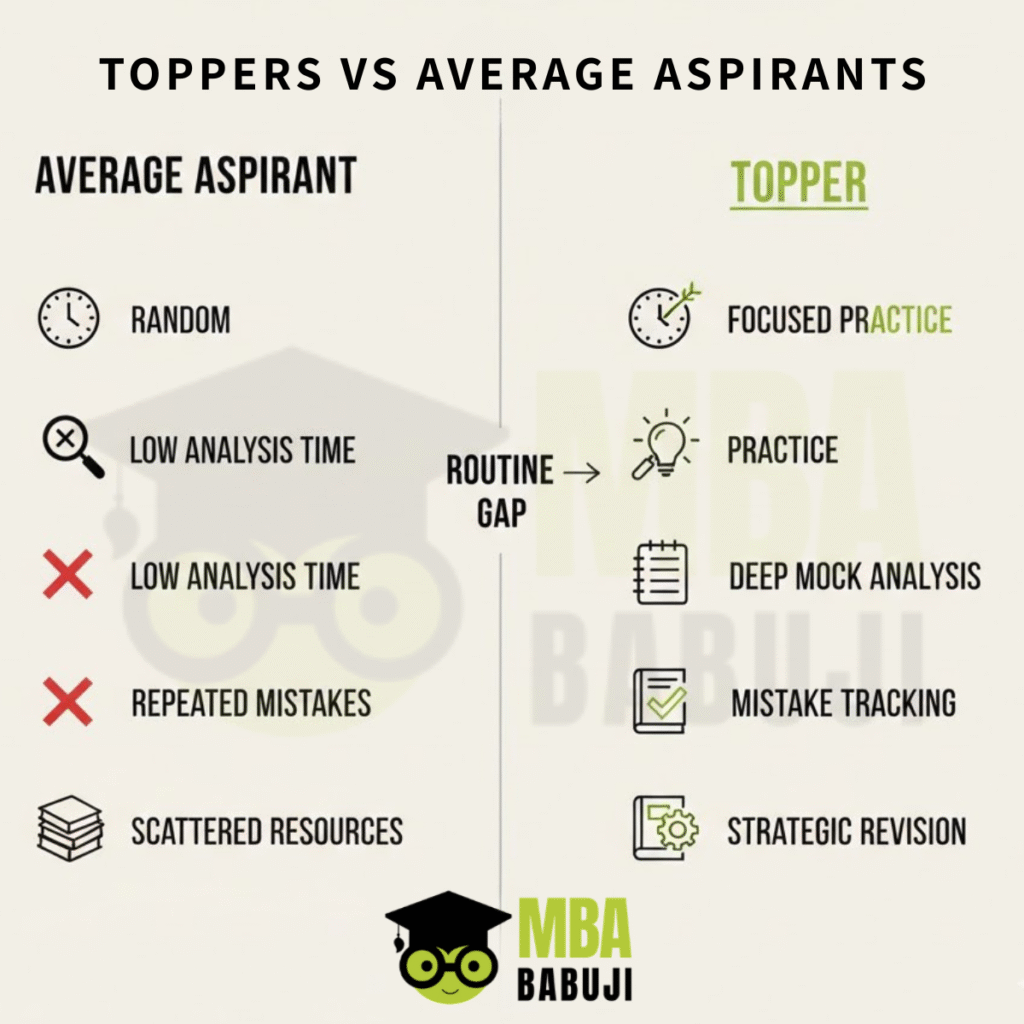
Toppers do not necessarily study longer — they study more deliberately.
1. Focused Practice Over Random Practice
They practice targeted question sets based on weak areas, not random chapters.
2. Deep Mock Analysis
Mocks are treated as learning tools, not performance tests.
They analyze:
- Wrong answers
- Guessed answers
- Time wasted
- Better approaches
3. Error Tracking
They maintain a mistake log to ensure errors are not repeated.
4. Quality Over Quantity
They solve fewer questions but extract more learning from each one.
5. Fixed Daily Structure
Their day includes:
- Practice
- Analysis
- Revision
- Timed drills
6. Strategic Revision
Instead of rereading everything, they revise based on previous mistakes and exam patterns.
How to Fix This Habit: Practical, Actionable Steps

1. Shift from “More Study” to “Smarter Study.”
Replace:
- Random practice
With: - Topic-wise, weakness-focused practice
Ask after every session:
“What did I learn today?”
2. Make Mock Analysis Non-Negotiable
For every mock:
- Spend 2–3 hours analyzing
- Identify mistakes, slow areas, and poor decisions
- Write down lessons learned
Mock attempts without analysis are almost wasted effort.
3. Track Mistakes Daily
Maintain a simple mistake log:
- Type of error
- Correct method
- Reason for the mistake
- How to avoid it next time
This turns mistakes into learning tools.
4. Limit Resources and Master Them
Choose one strong source per section and stick to it.
Depth beats variety in CAT and XAT preparation.
5. Measure Progress Weekly, Not Emotionally
Track:
- Accuracy percentage
- Time per question
- Mock score trends
- Sectional improvements
Progress should be visible in data, not just feelings.
6. Structure Your Daily Routine
A practical daily flow could be:
- 2 hours focused practice
- 1 hour error analysis
- 1 hour revision
- 30–45 minutes sectional timed practice
This ensures time creates measurable improvement.
Conclusion: Time Doesn’t Matter — Usage Does
The biggest time-wasting habit in CAT, XAT, and CET preparation is not laziness or lack of effort.
It is studying without structure, feedback, and reflection.
Many aspirants work hard — but progress comes only when effort is guided, analyzed, and corrected.
Success in MBA entrance exams depends less on how many hours you study and more on how effectively each hour is used.
A small improvement in daily study behavior can create a big improvement in percentile over time.
FAQs
1. How many mocks should I take for CAT and XAT?
Quality matters more than quantity. Take mocks regularly, but spend more time analyzing than attempting.
2. Why am I solving many questions but not improving accuracy?
Most likely because mistakes are not being reviewed or understood properly.
3. Is studying longer better for MBA entrance exams?
Not necessarily. Structured, focused study is more effective than long, unplanned hours.
4. How long does it take to fix poor study habits?
Visible improvement can begin within 3–6 weeks if analysis and structure are followed consistently.