
How Overconfidence Destroys MBA Entrance Scores: The Silent Killer Most Aspirants Ignore
Overconfidence is rarely discussed in MBA entrance preparation — yet it is one of the biggest hidden reasons behind low percentiles.
Most students don’t fail CAT, XAT, CET, NMAT, or SNAP because they lack ability. They fail because they assume they are better than the paper, better than the crowd, or better than their preparation actually is.
Overconfidence doesn’t look like arrogance.
It looks like comfort.
And comfort is dangerous in competitive exams.
Why Overconfidence Is More Dangerous Than Weak Preparation
Weak preparation is visible.
Overconfidence is silent.
Students who are underprepared usually:
- Respect the exam
- Stick to basics
- Avoid reckless attempts
Overconfident aspirants do the opposite — often unknowingly.
They stop correcting mistakes, stop analyzing mocks deeply, and start trusting instinct over logic.
Common Ways Overconfidence Creeps In
1. “Mocks Are Just Practice” Mindset
Many aspirants dismiss mock scores by saying:
- “Actual CAT will be easier.”
- “I’ll perform better on D-Da.y”
- “Mocks don’t reflect real performance.e”
Toppers treat mocks as reality checks, not ego cushions.
Ignoring mock feedback is the first sign of destructive overconfidence.
2. Attempting Too Many Questions
Overconfident students believe:
- More attempts = higher percentile
- Speed can compensate for errors
- Guesswork will balance out
In reality:
- CAT penalizes careless attempts
- Accuracy beats aggression
- One extra wrong answer can cancel two correct ones
3. Refusing to Skip Questions
Overconfidence makes aspirants emotionally attached to questions.
They think:
- “I should be able to solve this.”
- “This is my strong area.”
- “Let me try a bit more.”
Toppers think differently:
If it doesn’t click, it doesn’t deserve time.
4. Underestimating Easier Questions
Ironically, overconfidence also causes silly mistakes.
Students rush through easy questions, assuming they can’t go wrong — leading to:
- Calculation errors
- Misreading conditions
- Incorrect options chosen in haste
These are the most painful marks to lose.

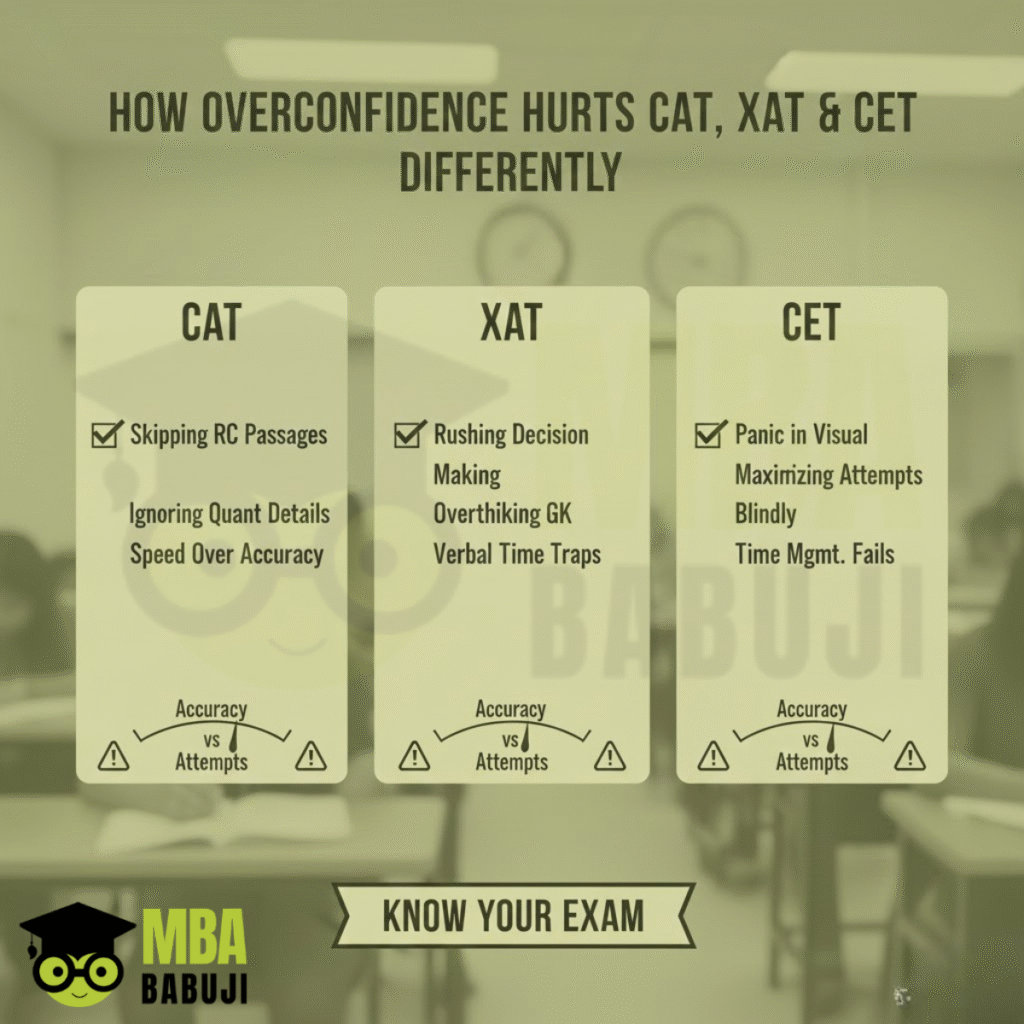
How Overconfidence Impacts Each MBA Exam
CAT
- Overattempting Quant and DILR
- Ignoring question selection
- Heavy negative marking impact
XAT
- Extreme answers in decision-making
- Relying on “common sense” instead of balance
- Misjudging ethical nuance
CET / NMAT / SNAP
- Speed obsession
- Guess-heavy strategies
- Lack of review discipline
Across exams, the pattern remains the same:
Confidence without control leads to collapse.
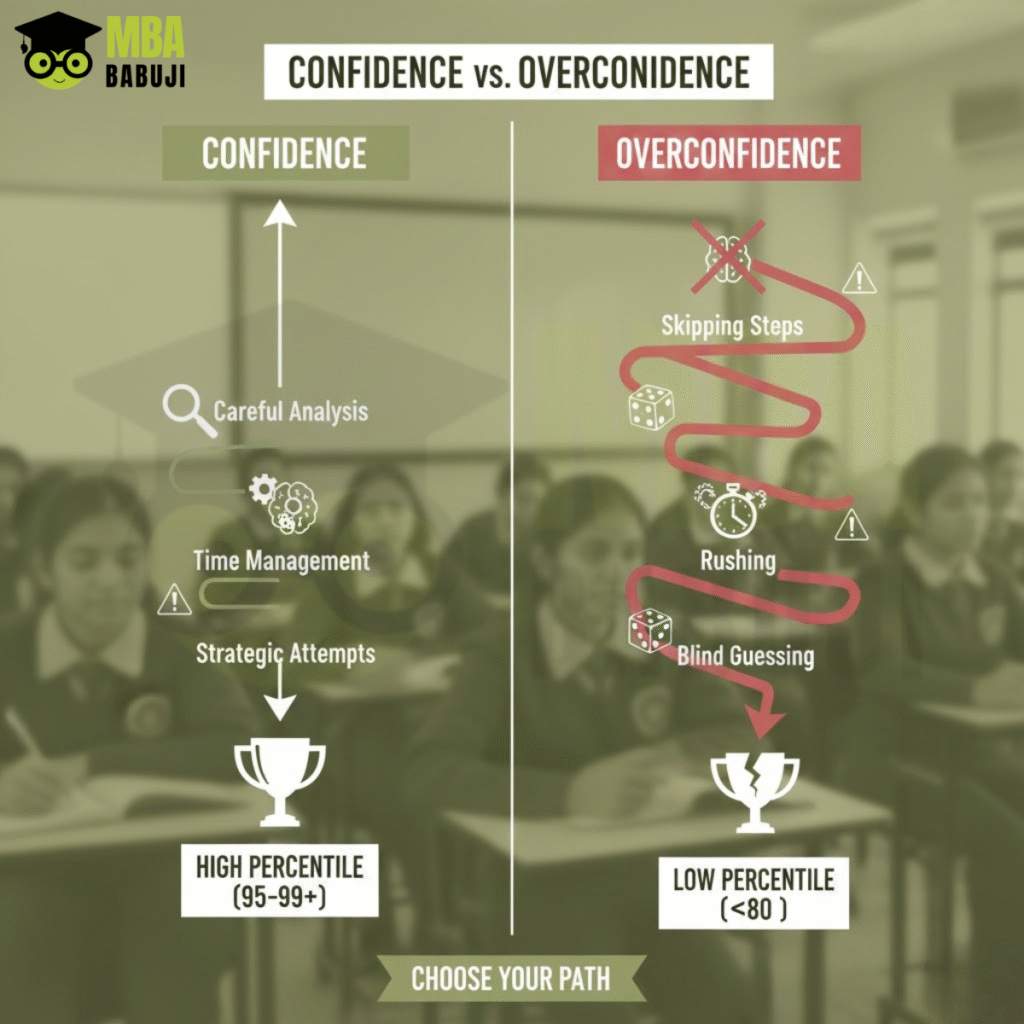
Confidence vs Overconfidence: What Toppers Get Right
| Confidence | Overconfidence |
|---|---|
| Respects the paper | Underestimates the exam |
| Focuses on accuracy | Focuses on attempts |
| Skips without ego | Forces questions |
| Learns from mocks | Defends mock scores |
Toppers are confident — but never careless.
How to Fix Overconfidence Before It Costs You Percentile
1. Let Data Judge You
Mock analysis matters more than mock scores.
Track:
- Accuracy rate
- Wrong question patterns
- Section-wise time loss
Numbers don’t lie.
2. Create a Skip Rule
Decide before the exam:
- When to skip
- When to move on
- When not to return
This removes ego-based decisions.
3. Respect Easy Questions
Slow down on sitters.
Treat easy questions as guaranteed marks, not speed breakers.
Final Takeaway
Overconfidence doesn’t announce itself loudly.
It quietly convinces you that:
- You’ve done enough
- You’ll manage somehow
- The exam won’t surprise you
MBA entrance exams punish assumptions.
Confidence helps you perform.
Overconfidence ensures regret.
FAQs
Q1. Is confidence bad for MBA exams?
No. Confidence is essential — but it must be backed by discipline and data.
Q2. How do I know if I’m overconfident?
If you ignore mock analysis, overattempt regularly, or justify mistakes, it’s a warning sign.
Q3. Can overconfidence affect repeaters more?
Yes. Repeaters often assume familiarity equals mastery, which leads to careless errors.
Q4. Is accuracy more important than attempts?
In most MBA exams, yes. Especially CAT and XAT.