
Why Self-Analysis Is the Most Underrated CAT Preparation Skill: Error Tracking, Mock Reflection & Continuous Improvement
Most CAT aspirants are not short of effort.
They solve questions daily.
They watch concept videos.
They attempt sectional tests.
They give mocks every week.
And still, a large number of serious students remain stuck in the same score range.
If you are in that phase — where you are studying regularly but not seeing a strong jump in performance — the problem is rarely your syllabus.
The problem is usually one missing skill:
Self-analysis.
In CAT preparation, self-analysis is not an optional habit. It is the skill that decides whether your hard work converts into percentile growth.
The Common CAT Routine Mistake That Looks Like Preparation
A typical serious aspirant’s week looks like this:
- 4–5 days of practice questions
- 1–2 mocks
- Some revision
- Dome YouTube strategy videos
- Maybe one sectional test
On paper, it looks like a perfect routine.
But in reality, most of the time goes into doing, not learning.
CAT is not a memory-based exam. It is a decision-based exam.
And decisions improve only when you study your own patterns.
That is why self-analysis becomes the most underrated (and most powerful) skill.
What Most Students Think Improves CAT Scores (But Doesn’t)
Before we go deeper, let’s be honest about what most students focus on.
Students usually believe improvement comes from:
- More questions solved
- More mocks attempted
- More formulas memorised
- More RCs read
- More DILR sets practised
These are useful, yes.
But these actions only work when paired with one thing:
👉 Understanding why you are losing marks.
Without that, you keep repeating the same mistakes with more intensity.
What Self-Analysis Really Means in CAT Preparation
Self-analysis is not “checking solutions”.
Self-analysis means:
- identifying what type of mistakes you make
- understanding why those mistakes happen
- tracking them consistently
- correcting them with small strategy changes
- ensuring they don’t repeat
It is basically a feedback loop.
Mocks and practice are input.
Self-analysis is a process.
Improvement is output.
Most aspirants do input.
Very few do processing.
Why Self-Analysis Is Underrated (And Why Students Avoid It)
Self-analysis is underrated because it is:
1) Not Visible Like Hard Work
Solving 50 questions feels productive.
But spending 90 minutes analyzing 15 questions feels slow — even though it improves you faster.
2) Mentally Uncomfortable
Self-analysis forces you to accept:
- You wasted time
- You chose the wrong questions
- Your accuracy is weak
- you panicked
- you guessed
- You didn’t manage the sections properly
Most students avoid this discomfort and jump to the next mock.
3) It Doesn’t Give Instant Satisfaction
Solving questions gives instant satisfaction.
Analysis gives slow improvement.
But CAT rewards slow improvement more than instant satisfaction.
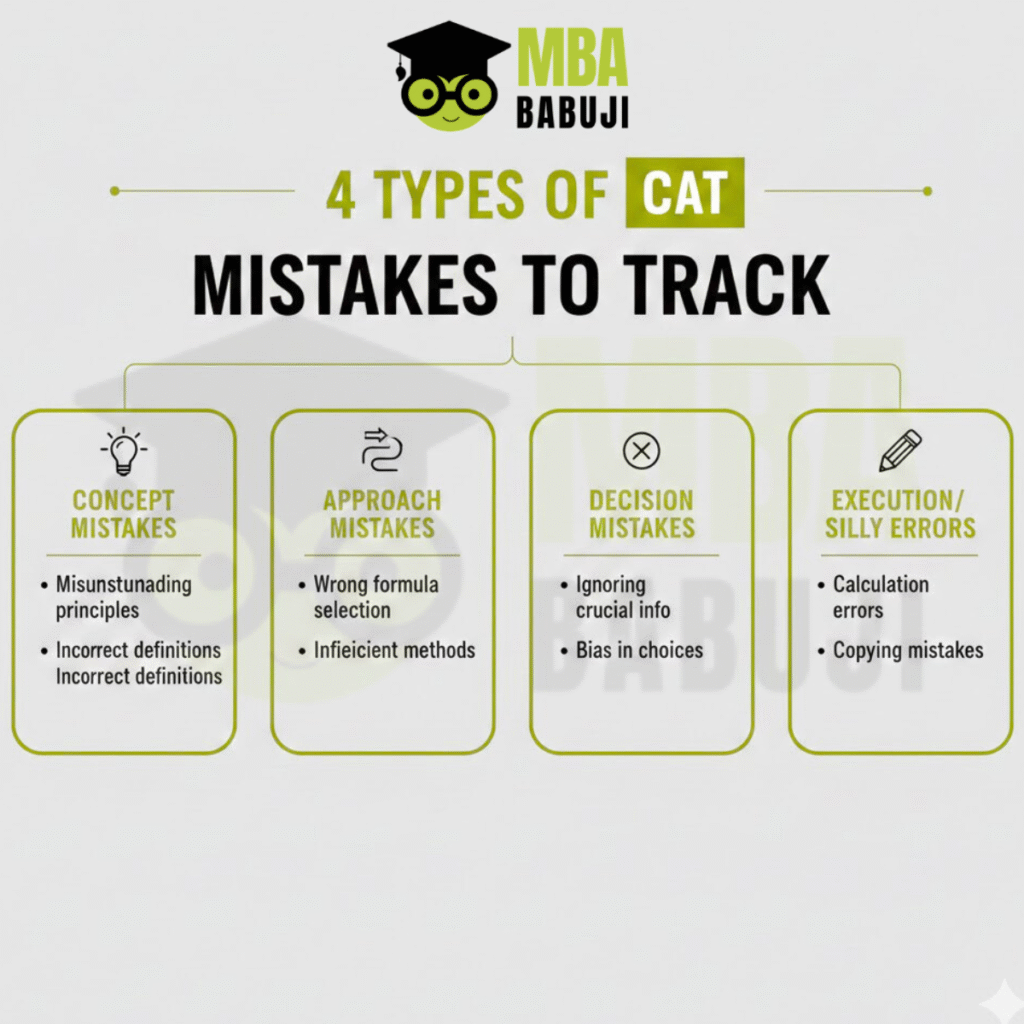
The 4 Types of Mistakes That Self-Analysis Reveals
Most students only think they have “wrong answers”.
But CAT mistakes are of different types.
When you start tracking properly, you usually find these 4 categories:
1) Concept Mistakes
You didn’t know the method or formula.
This is the easiest type to fix.
2) Approach Mistakes
You knew the concept but chose the wrong method.
Example:
- using long calculations instead of smart estimation
- choosing the wrong DILR set approach
- overthinking a simple VARC option
3) Decision Mistakes
This is the most common CAT problem.
Examples:
- attempting too many questions
- attempting a hard DILR set too early
- not skipping time traps
- spending 4 minutes on a QA question
4) Execution Mistakes (Silly Errors)
These are not small.
Examples:
- misreading “not” in a question
- calculation slip
- marking the wrong option
- reading RC too fast
- missing a condition in DILR
If these happen repeatedly, they are not “silly”.
They are a system problem.
How Self-Analysis Improves CAT Performance (Section-Wise)
Self-analysis helps every section differently.
VARC: Better Accuracy and Option Elimination
VARC is not random.
When you analyze properly, you start noticing:
- Which RC question types do you get wrong
- whether you misread passages
- whether you choose extreme options
- whether your elimination process is weak
Over time, your VARC accuracy improves naturally.
DILR: Better Set Selection and Time Control
Most DILR failure is not due to logic weakness.
It happens because of:
- wrong set selection
- not leaving a set early
- spending too long without progress
Self-analysis helps you identify your pattern:
- Do you get stuck in calculation-heavy sets?
- Do you waste time on puzzle sets?
- Do you panic when the first set feels hard?
This is how toppers attempt 2–3 sets consistently.
QA: Better Speed, Not Just More Practice
In Quant, many students know concepts.
But their scores remain average because they:
- attempt too many questions
- Don’t control time per question
- get trapped in lengthy algebra
- Do not skip tough geometry
Self-analysis tells you:
- Which topics are time traps
- Which topics are scoring
- where your accuracy drops
This is how QA becomes stable.
Why Mock Analysis Is More Important Than Mock Attempts
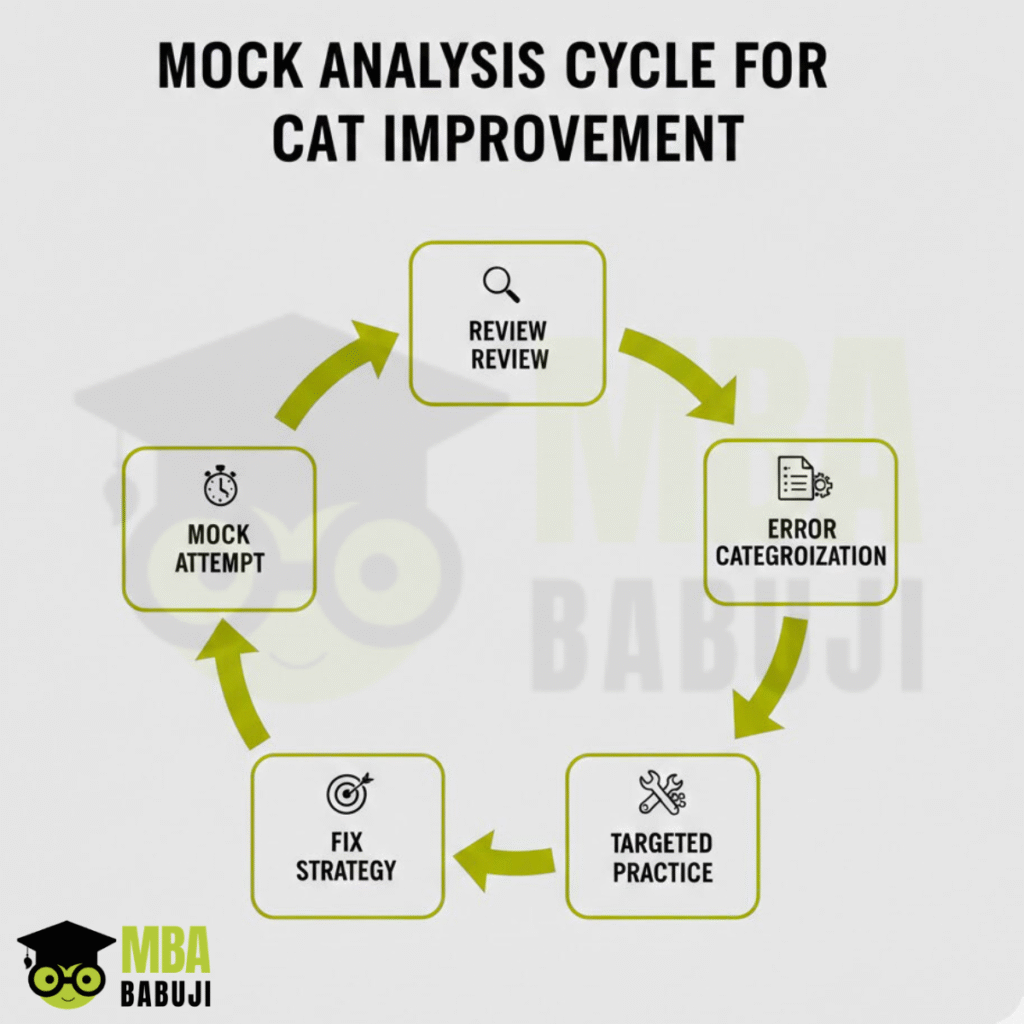
A mock is not a test.
A mock is a training tool.
But only if you analyze it properly.
If you give mocks without analysis:
- You repeat mistakes
- Your strategy doesn’t change
- Your accuracy doesn’t improve
- Your score fluctuates
- Your confidence becomes unstable
If you give mocks with analysis:
- You learn your weak patterns
- You correct decision-making
- You improve section balance
- You reduce time waste
- Your score becomes stable
This is why many students give 25 mocks and don’t improve.
Because they are testing themselves repeatedly, not training themselves.
Realistic Daily Examples: How Students Waste Improvement Opportunities
Here are some common real-life patterns.
Example 1: “I Solved 60 Questions Today.”
But:
- no mistake log
- no revision of errors
- no learning extracted
- no time analysis
Result: You stay busy, but you don’t evolve.
Example 2: “I Took a Mock, Score Was Low.”
Then:
- checked percentile
- watched the solution video
- moved on to the next mock
But no written analysis.
Result: Same mistakes again.
Example 3: “I Know My Mistakes Are Silly”
This is the biggest trap.
If “silly mistakes” happen in every mock, they are not silly.
They are:
- attention errors
- speed-pressure errors
- lack of checklist habits
Self-analysis is the only way to fix them.
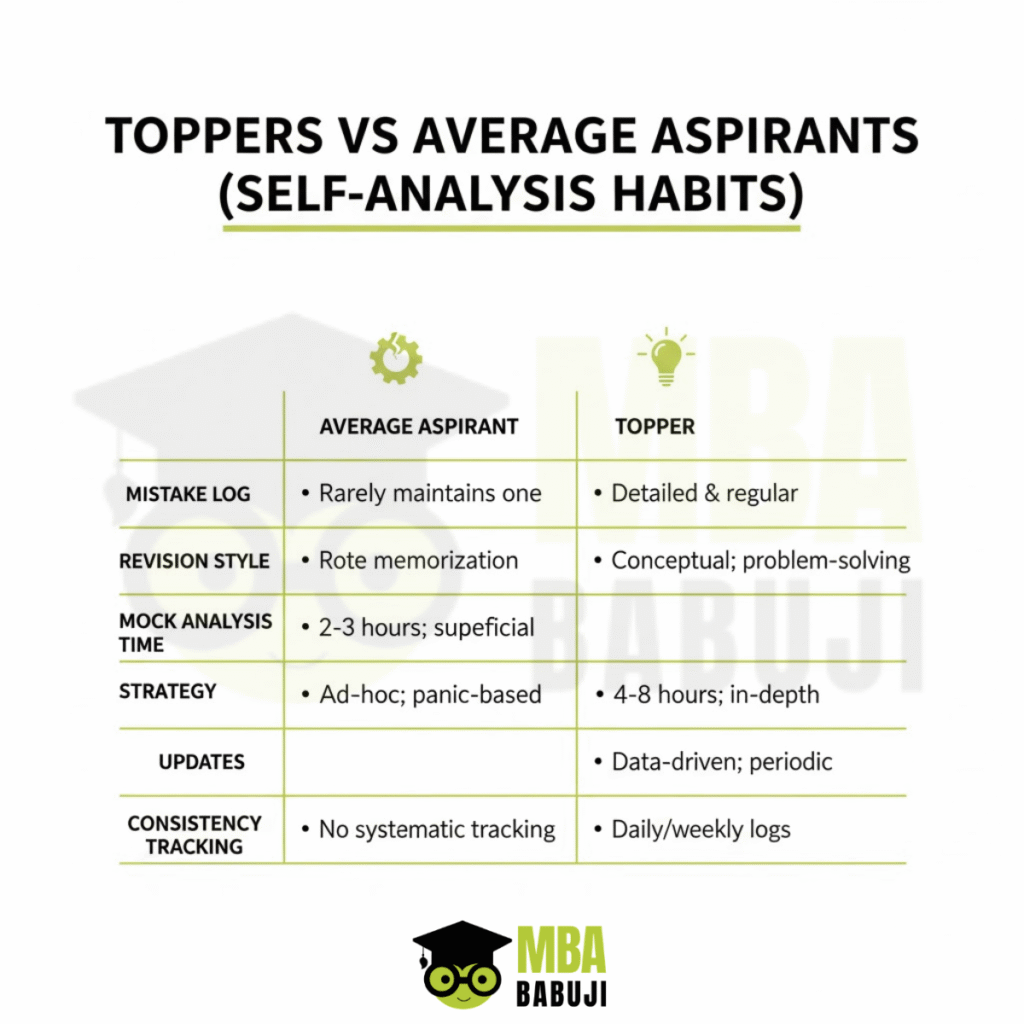
What Toppers Do Differently: They Track Patterns Like a Manager
CAT toppers don’t just practice more.
They manage their preparation like a project.
They track:
- accuracy trends
- time spent per section
- question selection quality
- Repeated mistake types
- scoring topics
- weak topic priority
They don’t rely on feelings.
They rely on data.
That is why their improvement is consistent.
The Most Effective Self-Analysis System (Simple and Practical)
You don’t need a complicated Excel dashboard.
You just need a simple, repeatable system.
Here is a realistic framework:
Step 1: Maintain a Mistake Log (Daily Habit)
After every mock or sectional, write down:
- question number
- topic
- your chosen option
- correct option
- mistake type (concept/approach/decision/execution)
- 1-line fix
This takes 20–30 minutes.
But it saves you weeks.
Step 2: Track Only 3 Key Metrics Weekly
You don’t need 20 metrics.
Track only:
- Attempts per section
- Accuracy % per section
- Time traps (where you wasted time)
These three decide your percentile growth.
Step 3: Identify Your “Repeat Mistakes”
Every Sunday, ask:
- Which mistake occurred 3+ times this week?
- Which topic keeps wasting time?
- Which section is unstable?
CAT improvement comes from removing repeated mistakes.
Step 4: Fix One Thing Per Week
Most students fail because they try to fix everything together.
Instead, fix one focus area weekly:
- Week 1: VARC accuracy
- Week 2: DILR set selection
- Week 3: QA time control
- Week 4: overall mock stability
This is realistic and measurable.
Step 5: Convert Mistakes Into Revision
A mistake log is useless if you don’t revise it.
Do 15 minutes daily:
- Revise your last 10 mistakes
- Solve 3 similar questions
- Note the correct approach
This is how errors stop repeating.
The Best Part About Self-Analysis: It Improves You Even Without More Study Time
This is the biggest advantage.
If you are a working professional or a college student with limited time, self-analysis is your shortcut.
Because it improves performance without increasing hours.
It improves the quality of your decisions.
And CAT is a decision exam.
Conclusion: CAT Scores Improve When You Study Yourself, Not Just the Syllabus
If your CAT scores are stuck, don’t assume you need more resources or harder questions.
Most of the time, you need:
- better error tracking
- deeper mock reflection
- consistent correction
- smarter weekly planning
Self-analysis is not glamorous.
It is not exciting.
But it is the skill that separates:
- repeaters from improvers
- mock takers from mock learners
- average percentiles from high percentiles
In CAT, your biggest improvement comes when you stop asking:
“How many questions did I solve today?”
And start asking:
“What did I learn from my mistakes today?”
FAQs
1) How much time should I spend on mock analysis for CAT?
Ideally, for a 2-hour mock, spend 2 to 3 hours on analysis across the next 1–2 days.
2) What should I track in self-analysis for CAT preparation?
Track:
- mistake type (concept/approach/decision/execution)
- topic
- time wasted
- reason for error
This is enough to improve consistently.
3) Why do my mistakes repeat even after practice?
Because practice without reflection becomes repetition.
Mistakes stop only when you track them and revise them systematically.
4) Can self-analysis improve CAT scores even if I have less study time?
Yes. Self-analysis improves efficiency. Many students improve more with 2 hours of smart analysis than with 6 hours of random practice.
✅ Meta Title (≤ 60 characters)
Why Self-Analysis Matters Most in CAT Preparation