
The Most Common Decision-Making Mistakes CAT Aspirants Make: Test Strategy, Accuracy vs Attempts, and Mock Behavior
Introduction: CAT Is a Decision-Making Test, Not Just a Knowledge Test
Many CAT aspirants believe that improving concepts or solving more questions will automatically increase their scores. However, a large portion of score difference in CAT, XAT, and CET comes from decision-making during the test, not just ability.
Two students with similar knowledge levels can end up with vastly different percentiles. The difference often lies in which questions they attempt, how they manage time, and how they respond to pressure.
CAT is not just a test of Quant, LRDI, and Verbal. It is a test of judgment, restraint, selection strategy, and execution discipline.
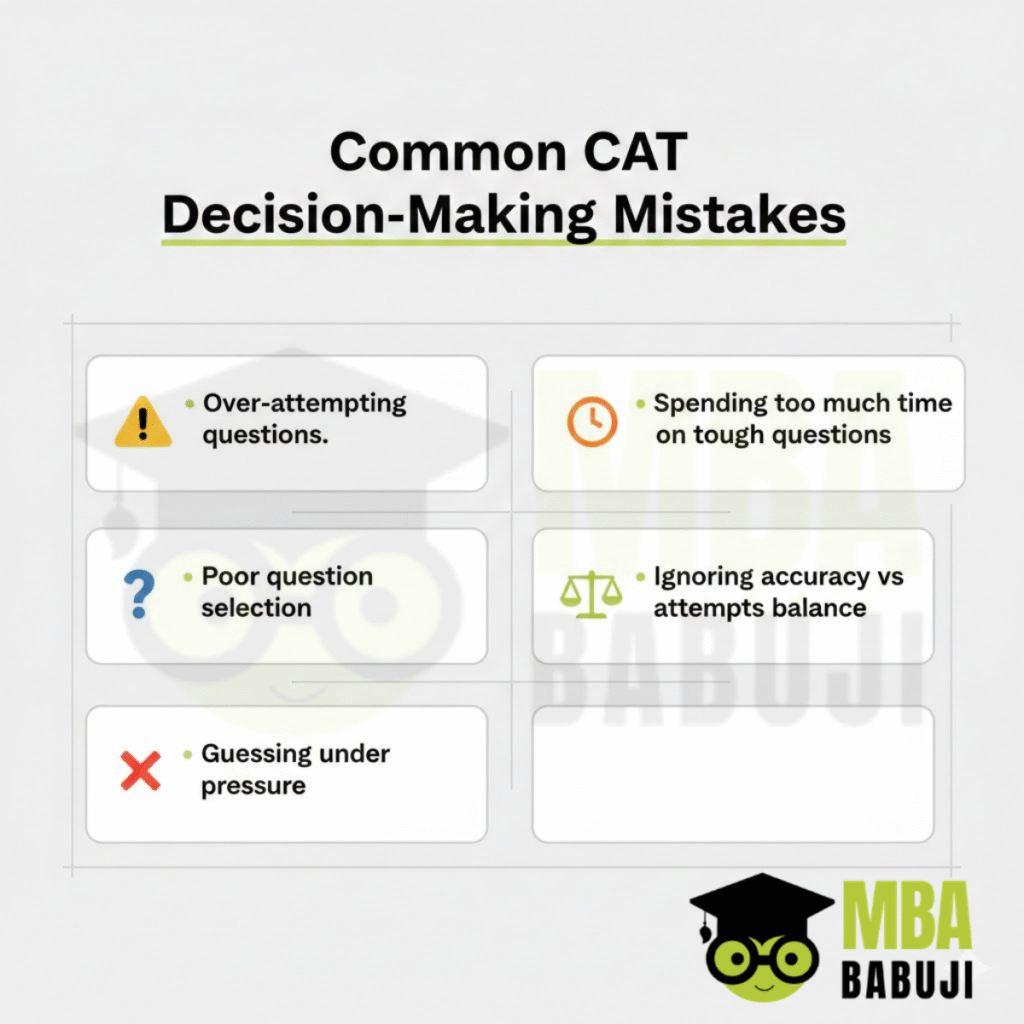
Why Decision-Making Matters More Than Students Realize
In competitive exams, marks are not only earned by solving questions — they are also protected by avoiding wrong decisions.
Poor test decisions lead to:
- Negative marking
- Wasted time on low-value questions
- Unbalanced section attempts
- Panic-driven guesswork
- Inconsistent mock scores
Most aspirants do not lose marks because they “don’t know enough,” but because they choose poorly under pressure.
Mistake 1: Trying to Attempt Too Many Questions
A common belief among aspirants is:
“If I attempt more questions, I will score more.”
In reality:
- Attempting more with low accuracy reduces score
- CAT rewards smart selection, not maximum attempts
- Over-attempting leads to careless errors and negative marking
Smarter approach:
Attempt fewer questions with higher accuracy and confidence.
Mistake 2: Spending Too Much Time on Difficult Questions
Many aspirants get emotionally attached to tough questions:
- “I’ve already spent 2 minutes, I must solve it.”
- “This looks solvable, I shouldn’t skip it.”
This behavior results in:
- Losing time for easier questions
- Rushed attempts later
- Lower overall accuracy
Correct mindset:
If a question doesn’t move forward within 40–60 seconds, skip it and return later if time permits.
Mistake 3: Ignoring Question Selection Strategy
Not all CAT questions are meant to be solved.
Mistakes include:
- Attempting questions in sequence without filtering
- Starting with tough questions instead of quick wins
- Ignoring high-confidence opportunities
Smart strategy:
- Scan the section first
- Identify easy and moderate questions
- Prioritize high-success probability questions
CAT rewards selection intelligence more than raw solving speed.
Mistake 4: Choosing Attempts Over Accuracy
Many aspirants sacrifice accuracy to increase attempts.
This causes:
- Negative marking
- Confidence drops
- Erratic score patterns
Better decision rule:
Attempt questions only when you are at least 80–90% confident in your solution.
A 90% accuracy with moderate attempts often outperforms 70% accuracy with high attempts.
Mistake 5: Letting Mock Scores Control Confidence
Students often:
- Panic after one bad mock
- Become overconfident after one good mock
- Change strategy too frequently based on score swings
Mocks are meant to guide strategy improvement, not emotional reactions.
Smarter approach:
Focus on decision errors, time usage, and accuracy trends, not just raw marks.
Mistake 6: Guessing Under Pressure
Blind or emotional guessing:
- Increases negative marking
- Disrupts rhythm
- Creates score volatility
CAT is not a guessing-friendly exam.
Better alternative:
Skip doubtful questions and use time to maximize sure-shot attempts.
Mistake 7: Poor Time Allocation Across Sections
Some aspirants:
- Spend too long on one section
- Rush another section
- Ignore sectional balance
Poor section-wise decisions lead to lost scoring opportunities.
Smart approach:
Follow a pre-decided time plan and adjust only if necessary.
Mistake 8: Repeating the Same Decision Errors in Mocks
Many students take mocks regularly, but:
- Do not analyze why wrong decisions were made
- Repeat the same selection mistakes
- Never build a mistake log
This leads to score stagnation despite effort.
Smart correction:
Track decision mistakes such as:
- Over-attempting
- Spending too long
- Guessing
- Choosing wrong difficulty level
How Toppers Make Better Decisions in CAT
Top scorers:
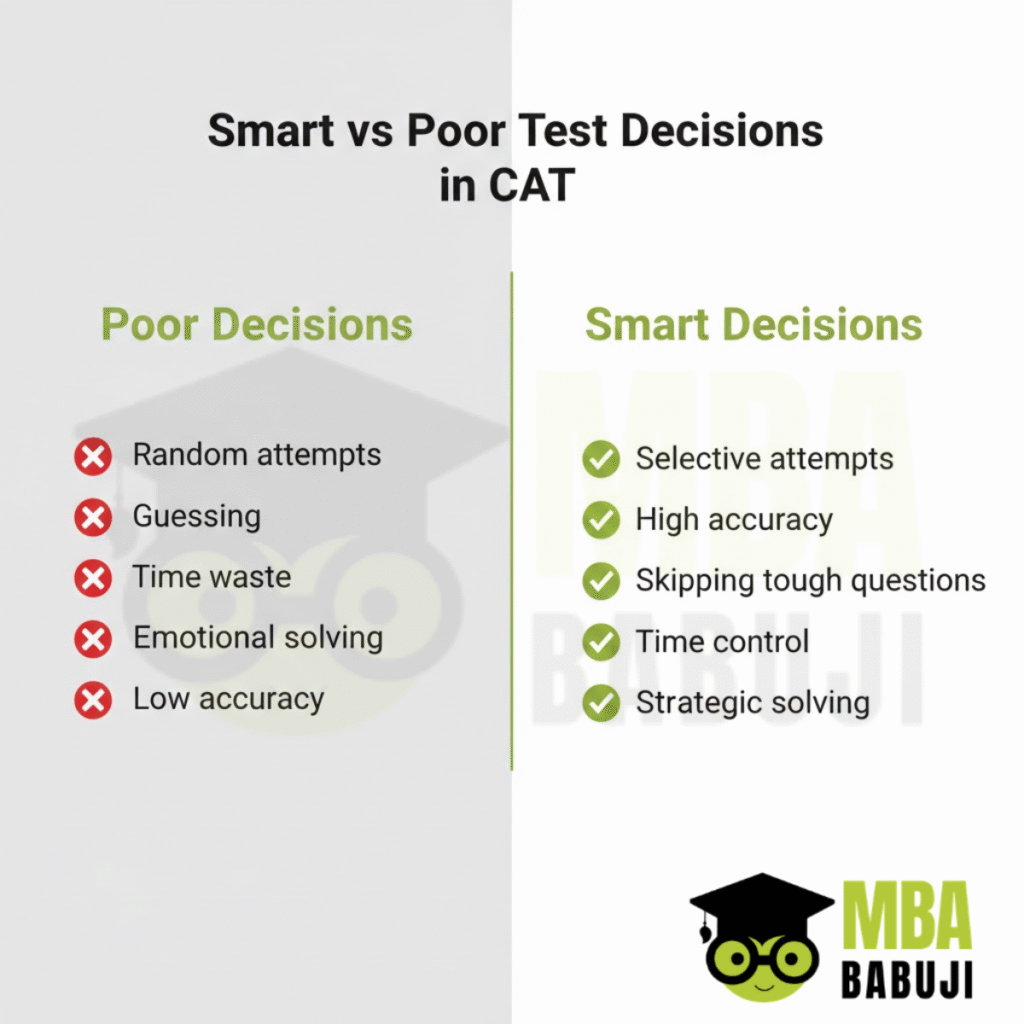
- Attempt only high-confidence questions
- Skip early instead of struggling
- Follow a planned section strategy
- Maintain emotional control
- Analyze mock decisions deeply
- Optimize accuracy rather than ego-based attempts
Their strength is not only knowledge — it is disciplined test behavior.

How to Improve Decision-Making for CAT & XAT
1. Practice Selective Solving
Do not solve everything. Practice choosing the right questions.
2. Track Decision Errors in Mock Analysis
Maintain a log of:
- Time-waste decisions
- Guessing mistakes
- Over-attempt errors
3. Set Accuracy Benchmarks
Aim for 80–90% accuracy in attempted questions.
4. Build a Fixed Section Strategy
Decide in advance:
- How long to scan
- How many to attempt
- When to skip
5. Train Emotional Control
CAT rewards calm, not panic.
Conclusion: CAT Rewards Smart Decisions More Than Hard Effort
CAT is not only about knowing formulas or concepts. It is about making disciplined, logical, and strategic decisions under time pressure.
Aspirants who improve question selection, accuracy discipline, and mock behavior often see sharper score improvement than those who only increase study hours.
In CAT preparation, what you skip matters as much as what you solve.
FAQs
1. Is attempting more questions always better in CAT?
No. Higher accuracy with fewer attempts usually scores better than low accuracy with many attempts.
2. How can I avoid making emotional decisions in mocks?
Follow a fixed strategy, track decision mistakes, and focus on process rather than score.
3. What is a good accuracy target in CAT mocks?
Aim for 80–90% accuracy in attempted questions.
4. How do I improve question selection skills?
Practice selective solving and analyze which questions you should have skipped or attempted.