
The 3-Stage Preparation Strategy for CAT: Learn → Practice → Mock (Perfect for Beginners & Repeaters)
Preparing for CAT is not just about studying more hours—it’s about following the right process in the right order.
Every year, thousands of aspirants start CAT preparation with full energy, but soon get stuck in confusion:
- “Should I start mocks early?”
- “Why am I scoring low even after studying daily?”
- “Why does my performance fluctuate so much?”
- “I’m a repeater. What should I do differently this time?”
The truth is: CAT is a process-driven exam.
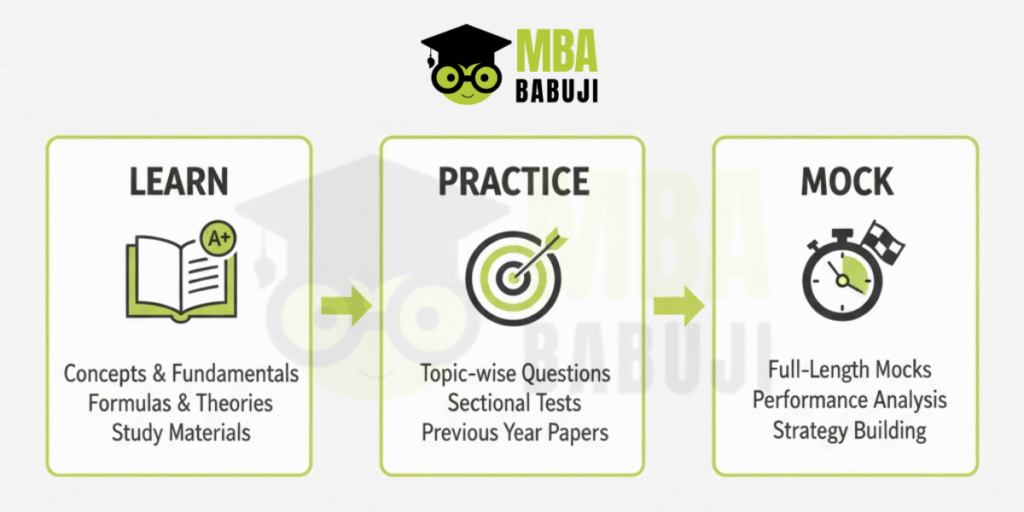
And the smartest way to prepare is by following a proven structure:
✅ Learn → Practice → Mock
This is the 3-stage CAT preparation strategy that works for:
- Beginners who don’t know where to start
- Repeaters who studied before but couldn’t convert the score
- Working professionals who need a structured plan
- Students who want consistency and confidence
Let’s break it down in a detailed, practical way.
Why Most CAT Aspirants Fail Without a Structure
Many students jump directly into mocks too early, or they keep solving random questions without mastering concepts.
This creates 3 major problems:
1) You Study, But You Don’t Improve
Because improvement comes from feedback + correction, not just studying.
2) Your Accuracy Stays Low
Without topic mastery, speed practice becomes useless.
3) Your Mock Scores Remain Unstable
You might score 50 one day and 25 the next—because your foundation is weak.
That’s why the Learn → Practice → Mock strategy is so powerful. It builds preparation step-by-step.
Stage 1: LEARN (Build Your CAT Foundation)
The first stage is about learning concepts properly, especially for Quant and DILR.
Many beginners ignore this stage and directly start question-solving.
But CAT is not a board exam—CAT tests:
- Concept clarity
- Logical thinking
- Pattern recognition
- Time pressure decision-making
So if your base is weak, mocks will only create stress.
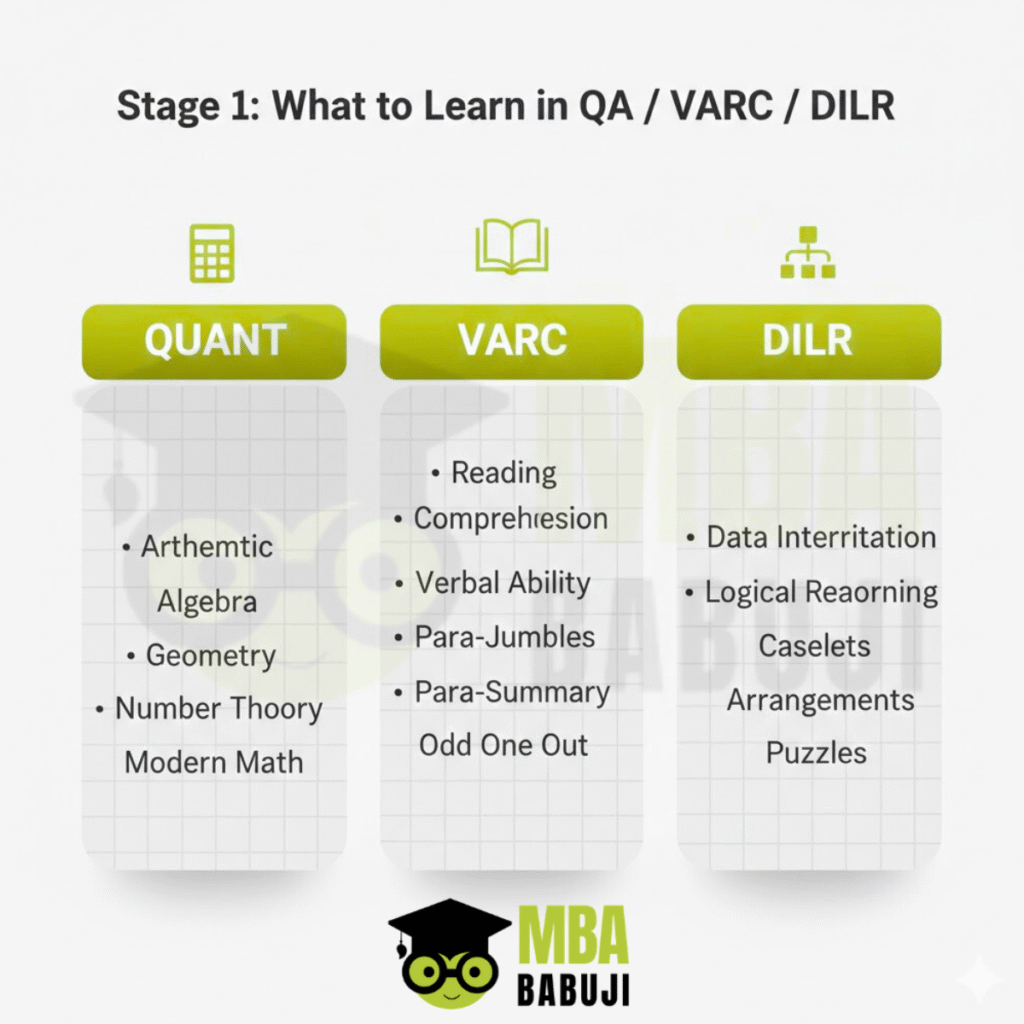
What to Learn in Each Section (Stage 1)
Quant (QA)
Focus on building the fundamentals of:
- Arithmetic (Percentages, Ratio, Profit-Loss, SI-CI, Time-Speed, Averages)
- Algebra (Linear equations, Quadratic, Inequalities, Functions)
- Geometry (Triangles, Circles, Mensuration)
- Number System (Divisibility, remainders, factors)
- Modern Math (P&C, Probability, Set Theory)
Goal: Not to master everything instantly, but to understand how and why.
VARC
Learning in VARC is not like Quant.
Here, your “learning” includes:
- Understanding RC question types
- Building vocabulary through context
- Learning how to eliminate options
- Understanding tone, inference, and main idea
Goal: Build reading ability + comprehension logic.
DILR
DILR is where most students panic.
In Stage 1, focus on learning:
- Common set types (tables, bar graphs, games & tournaments, routes, arrangements)
- How to structure data
- How to make cases and deductions
- How to avoid over-calculation
Goal: Learn how to approach a set, not how to solve 100 sets.
Stage 1 Mistake to Avoid
❌ Watching endless videos but not solving anything.
Learning must always be paired with small practice.
How Long Should Stage 1 Take?
This depends on your level:
- Beginners: 6–10 weeks
- Repeaters: 3–6 weeks
- Working Professionals: 8–12 weeks (but consistent)
Stage 2: PRACTICE (Turn Concepts Into Speed + Accuracy)
Stage 2 is where your real CAT performance is built.
Because CAT does not reward knowledge—it rewards execution under pressure.
You might know the formula, but in CAT you must apply it within seconds.
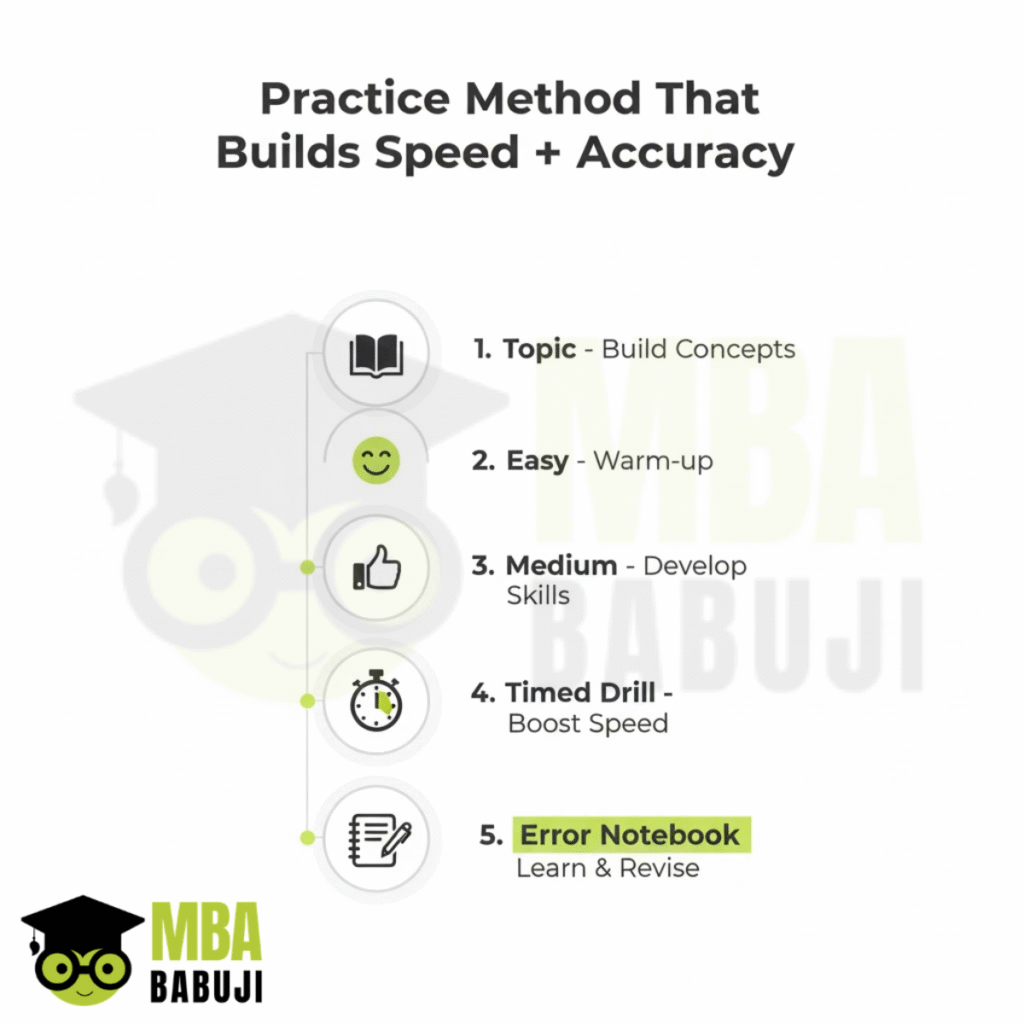
What Practice Means in CAT Preparation
Practice is not solving random questions.
It means:
- Topic-wise practice
- Timed practice
- Error tracking
- Repetition of weak areas
- Increasing difficulty gradually
Practice Strategy for Quant (QA)
Step-by-step:
- Solve 20–30 easy questions per topic
- Move to medium-level questions
- Do timed sets: 10 questions in 20 minutes
- Create a “formula + traps notebook”
Goal: Improve accuracy first, then speed.
Practice Strategy for VARC
Best method:
- Daily RC practice (2–3 passages)
- Daily VA practice (10–15 questions)
- Weekly sectional test
Also build:
- Reading habit (30 minutes daily)
- Skimming ability
- Option elimination skills
Goal: Become comfortable with long passages and confusing options.
Practice Strategy for DILR
DILR practice is different.
Instead of doing 50 easy sets, do this:
- Solve 2 sets daily (quality > quantity)
- Spend time understanding the structure
- Learn 5–6 recurring patterns
- Practice selection (which set to attempt first)
Goal: Improve set selection and confidence.
Stage 2 Mistake to Avoid
❌ Practicing without analysis.
If you solve 100 questions but don’t know:
- Why did you got wrong
- What concept was missing
- What shortcut existed
Then your practice becomes “busy work.”
How Long Should Stage 2 Take?
- Beginners: 8–12 weeks
- Repeaters: 6–10 weeks
- Late starters: minimum 5 weeks
Stage 3: MOCK (Convert Preparation Into Percentile)
This is the final stage and the most important one.
Mocks are not for checking your score.
Mocks are for building your CAT temperament.
CAT is a game of:
- Time management
- Question selection
- Skipping strategy
- Sectional control
- Pressure handling
Mocks train your brain for the real exam environment.
When Should You Start Mocks?
Beginners
Start mocks after:
- basic Arithmetic + Algebra is done
- RC practice has started
- DILR patterns are understood
Usually after 6–8 weeks of preparation.
Repeaters
Start earlier, but carefully.
You already know the exam, so mocks can be started in 3–4 weeks.
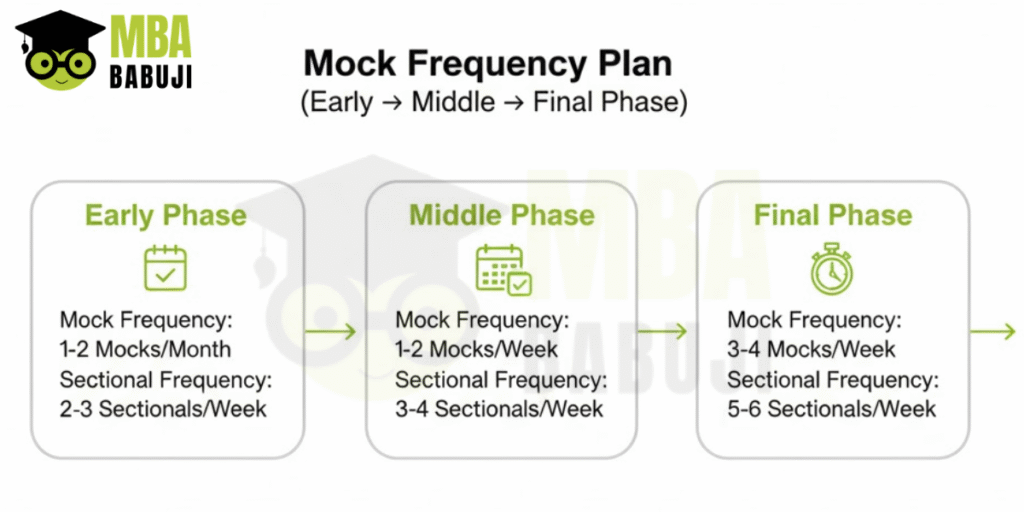
Ideal Mock Frequency
A smart CAT mock schedule:
Early Phase (first 1–2 months of mocks)
- 1 mock per week
- 2 sectionals per week
Middle Phase
- 2 mocks per week
- 3–4 sectionals per week
Final Phase (last 6 weeks)
- 2–3 mocks per week
- 4–5 sectionals per week
- Full analysis compulsory
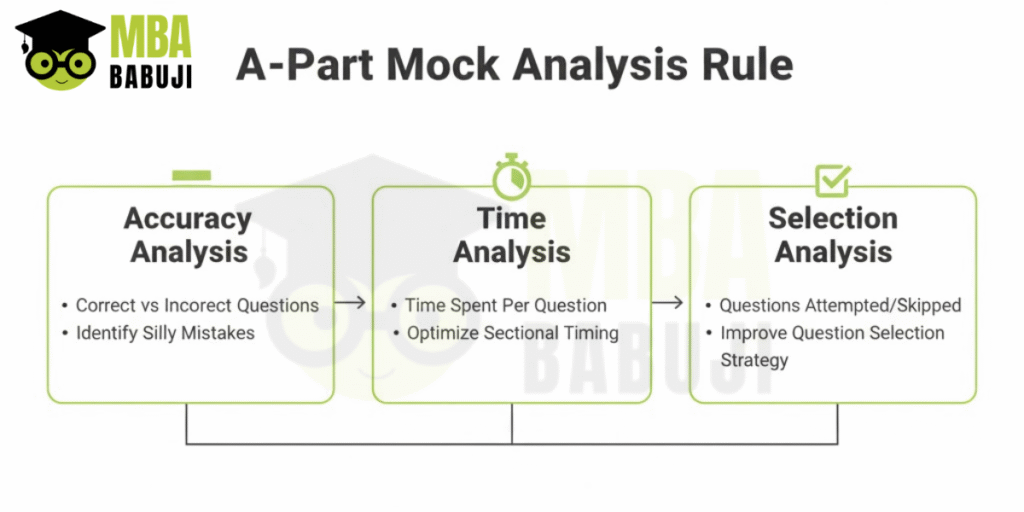
The 3-Part Mock Analysis Rule
After every mock, do this:
1) Accuracy Analysis
- Which section has low accuracy?
- Which question type is causing errors?
2) Time Analysis
- Where did you waste time?
- Which question took 4–5 minutes unnecessarily?
3) Selection Analysis
- Which questions should you have skipped?
- Which easy questions did you miss?
Mocks are only useful if you do analysis.
Stage 3 Mistake to Avoid
❌ Giving mocks like an exam, but not reviewing them.
Remember:
Your score improves after the mock, not during the mock.
How Beginners Should Use This 3-Stage Strategy
Beginners should follow this order strictly:
Step 1: Learn basics (foundation)
Step 2: Practice topic-wise
Step 3: Start mocks gradually
Step 4: Improve through mock analysis
This prevents:
- confusion
- panic
- early demotivation
How Repeaters Should Use This 3-Stage Strategy
Repeaters should modify it slightly:
Learn (short revision)
Focus only on:
- weak topics
- forgotten formulas
- concepts that caused repeated mistakes
Practice (more intense)
Repeaters need more:
- timed practice
- medium-hard questions
- DILR sets
Mock (start early)
Repeaters should:
- Start mocks early
- do a deep analysis
- Focus on the selection strategy
Because repeaters often know but lack:
- mock temperament
- strategy
- discipline
A Perfect 3-Stage Weekly Plan (Sample)
Here’s a simple weekly model:
Monday to Friday
- 2 hours concept + practice
- 30 minutes VARC reading/RC
- 1 DILR set daily
Saturday
- Sectional tests + analysis
Sunday
- Full mock + 2–3 hours analysis
This is enough for:
- students
- college aspirants
- working professionals
The Final Key: The Cycle That Makes CAT Easy
The real magic is when your preparation becomes a loop:
✅ Learn → Practice → Mock → Analyze → Improve → Repeat
This is how toppers build 99+ percentile.
Not by studying 10 hours daily, but by following a repeatable system.
Conclusion: Why This Strategy Works for Everyone
CAT is unpredictable.
But your preparation should not be.
The Learn → Practice → Mock strategy ensures:
- strong fundamentals
- better speed + accuracy
- stable mock scores
- improved selection strategy
- confidence under pressure
Whether you’re a beginner or a repeater, if you follow this structure consistently, you will see measurable improvement in 4–6 weeks.
FAQs: The 3-Stage CAT Preparation Strategy
Q1. Is the Learn → Practice → Mock strategy enough to crack CAT?
Yes. This is the most reliable structure because it builds fundamentals, execution skills, and exam temperament together.
Q2. When should I start giving mocks for CAT?
Beginners should start after 6–8 weeks of basic preparation. Repeaters can start earlier (3–4 weeks).
Q3. How many mocks are enough for CAT preparation?
Ideally, 25–40 full mocks with proper analysis are enough for a strong attempt.
Q4. What if my mock scores are not improving?
Mock scores improve only when you analyze mistakes and fix weak areas. If you only attempt mocks without analysis, improvement becomes slow.
Q5. Should I focus more on practice or mocks?
If you’re in early preparation, practice is more important. In later stages, mocks become more important.
Q6. How much time should I spend on mock analysis?
At least 2–3 hours per mock. Some high-quality analysis sessions can even take 4 hours.
Q7. Can working professionals follow this strategy?
Yes. Even 2–3 hours daily is enough if the structure is followed properly.
Q8. Which stage is most important for repeaters?
Repeaters must focus more on Stage 3 (Mock + Analysis) because they already have a foundation.