
Sectional Tests vs Full-Length Mocks: What to Do First?
Correct Order Strategy for Beginners to Advanced CAT Aspirants
Introduction: Most CAT Aspirants Start Mocks at the Wrong Time
If you are preparing for CAT, XAT, or MBA CET, you’ve probably heard this advice:
“Start giving mocks early.”
So students start full-length mocks within the first 2–3 weeks.
Then what happens?
- VARC feels unpredictable
- DILR becomes a disaster
- Quant feels too long
- Scores are low
- Confidence drops
- Students stop giving mocks regularly
This is one of the biggest reasons aspirants feel stuck even after months of preparation.
The real issue is not mock difficulty.
The issue is: most students don’t follow the correct order.
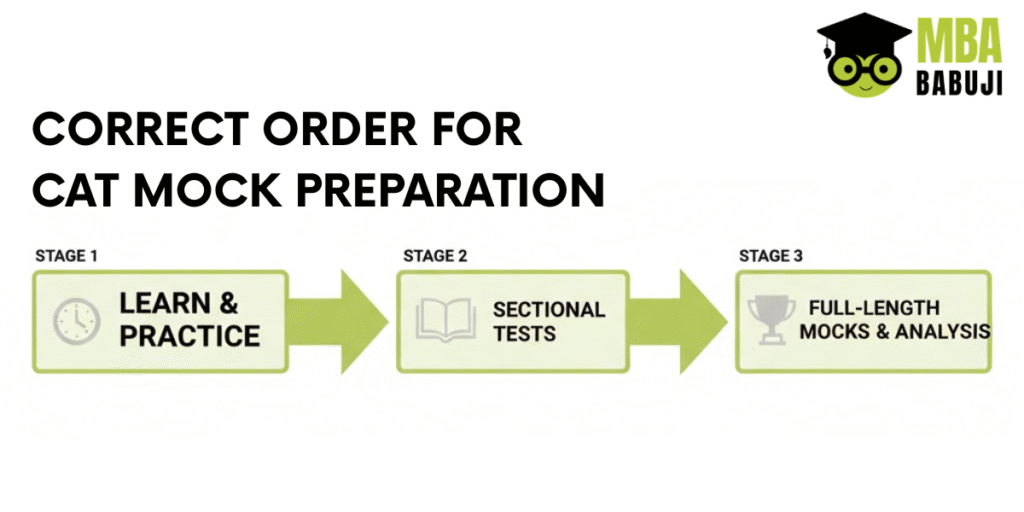
CAT preparation needs a sequence:
Learn → Sectional Tests → Full-Length Mocks → Deep Analysis
If you follow the right progression, your mock scores will improve naturally without stress.
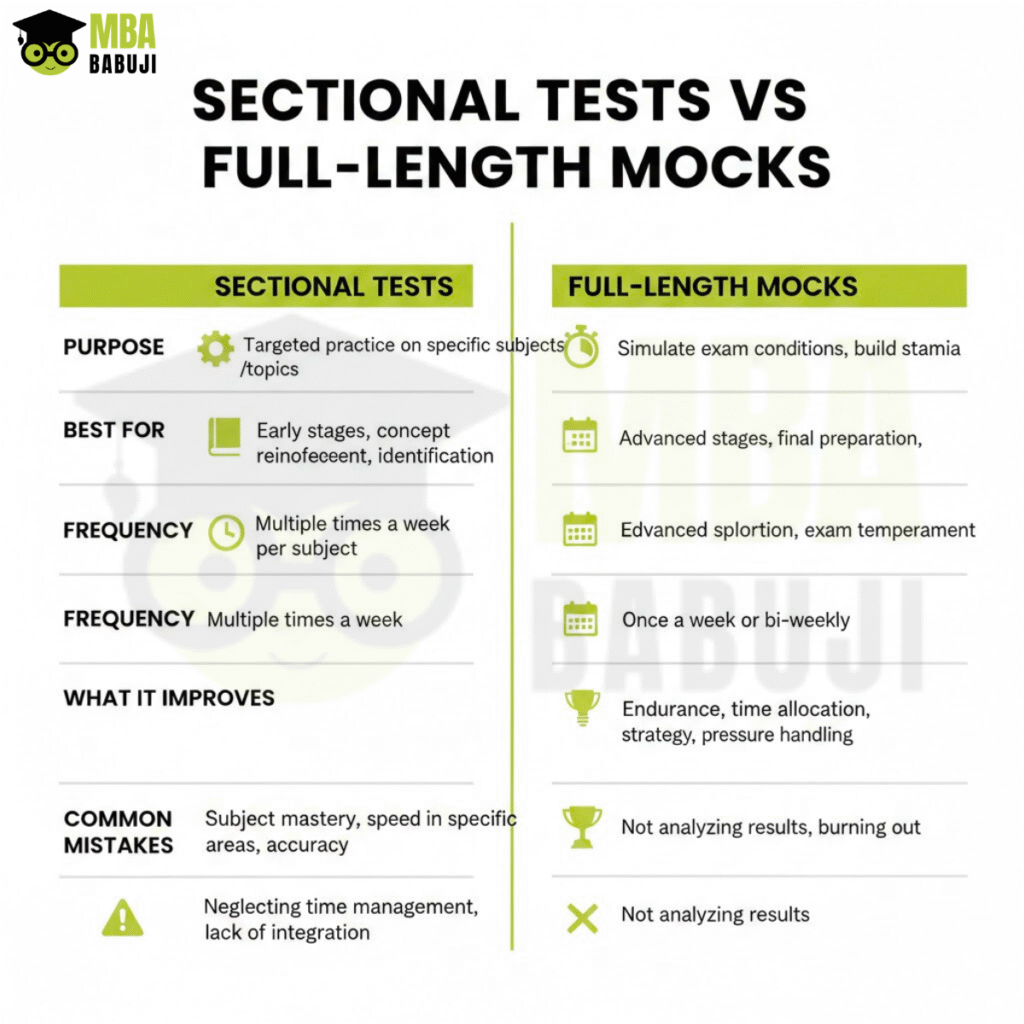
What Are Sectional Tests and Full-Length Mocks? (Quick Clarity)
Before we decide what to do first, let’s define them clearly.
Sectional Tests
These are tests focused on one section at a time:
- VARC only (40 minutes)
- DILR only (40 minutes)
- Quant only (40 minutes)
They help you practice:
- topic-wise skills
- timing within one section
- section-level strategy
Full-Length Mocks
These are complete CAT-style tests:
- VARC + DILR + QA
- 2 hours total
- fixed section order
- exam-like pressure and transitions
They help you build:
- full exam temperament
- decision-making under fatigue
- section switching ability
- overall percentile improvement
Both are important.
But the order matters.
The Big Question: What Should You Do First?
Here is the mentor-style answer:
Beginners should start with Sectional Tests first.
Advanced aspirants should shift to Full-Length Mocks faster.
Repeaters should use both in a structured cycle.
Because full mocks test your complete readiness.
But sectionals build your readiness.
Why Full-Length Mocks Feel “Too Early” for Many Students
Many aspirants start full mocks too soon and face these issues:
1) They Don’t Have a Base Strategy Yet
Without strategy, a mock becomes random attempts.
2) They Don’t Know Their Strong Topics
So they waste time on low-return questions.
3) They Panic When the First Section Goes Bad
A poor VARC start ruins DILR and Quant.
4) They Skip Analysis Because the Mock Feels Too Hard
And then mocks stop becoming learning tools.
This is why beginners should not jump into full mocks without sectional discipline.
The Right Order: Beginner to Advanced Mock Progression
Here is the most effective order used by consistent top scorers:
Stage 1: Learning + Basic Practice
(First 3–6 weeks, depending on your level)
- Learn core concepts in Quant
- Learn RC approach in VARC
- Practice standard DILR set types
- Build accuracy slowly
At this stage, full mocks are not needed frequently.
Stage 2: Sectional Tests + Timed Practice
(Next 4–8 weeks)
Now you start:
- section-wise timing discipline
- question selection within one section
- reducing silly mistakes
This stage is where real improvement begins.
Stage 3: Full-Length Mocks + Deep Analysis
(Last 8–12 weeks before CAT)
Now you shift to:
- full exam simulation
- overall strategy
- percentile improvement
- stamina + calmness
At this stage, full mocks become the main tool.
Why Sectional Tests Are More Powerful Than Students Think
Many aspirants underestimate sectionals because they feel “small”.
But sectionals do something full mocks cannot do easily:
1) They Fix Your Weakest Section Faster
If your DILR is weak, you need DILR-focused tests.
Full mocks give you only 40 minutes of DILR per test.
But sectionals allow you to do 2–3 DILR tests weekly.
That improves much faster.
2) They Help You Build Timing Instinct
Timing is different in each section.
- VARC needs fast reading + calm judgement
- DILR needs set selection
- Quant needs controlled speed
Sectionals help you develop section-specific timing.
3) They Make Analysis Easier
Mock analysis is tough.
But sectional analysis is cleaner because:
- fewer questions
- one type of mistake pattern
- easier tracking
This is why beginners should start here.
When Full-Length Mocks Become Necessary
Full mocks become essential when:
1) You Can Handle 40 Minutes per Section
If you still lose control in one section, sectionals are still needed.
2) You Have a Basic Attempt Strategy
Example:
- VARC: 3 RCs + VA
- DILR: 2 sets target
- QA: 12–15 questions smartly
Without this, full mocks are just random.
3) You Want Percentile Improvement, Not Just Topic Learning
Percentile depends on:
- decisions
- skipping ability
- time allocation
- stamina
Only full mocks build these.
The Most Common Mistake: Replacing Sectionals Completely
Once students start full mocks, they stop sectionals.
This is a major mistake.
Because mocks show your weaknesses, but sectionals fix them.
A Smart Cycle Looks Like This:
- Full mock → identify weak section
- Sectionals → improve that section
- Next mock → test improvement
This loop gives consistent growth.
The Best Mock Strategy for Different Types of Students
1) Beginner (First-Time CAT Aspirant)
Goal: Build base + reduce panic
Best approach:
- 70% sectionals
- 30% full mocks
Frequency:
- 2 sectionals per week
- 1 full mock every 10–14 days
2) Intermediate Student (Score Stuck in Average Range)
Goal: Improve weak section + increase attempts
Best approach:
- 50% sectionals
- 50% full mocks
Frequency:
- 2 full mocks per week
- 2 sectionals per week
- deep analysis mandatory
3) Advanced Student (Already Close to Target Percentile)
Goal: consistency + decision-making
Best approach:
- 30% sectionals
- 70% full mocks
Frequency:
- 2–3 full mocks per week
- 1 sectional to maintain weak section
4) Repeater (Giving CAT Again)
Repeaters usually have knowledge.
But they lack improvement.
Best approach:
- 1 full mock every 3–4 days
- 2 sectionals weekly (especially DILR)
- strict error tracking
How to Use Sectionals Correctly (Most Students Use Them Wrong)
Sectionals are not just “practice”.
They should be used like mini-mocks.
Rules for Sectionals
1) Always Attempt in 40 Minutes
Never pause. Never extend time.
2) Have a Clear Attempt Plan
Example for Quant:
- first 5 min scan
- pick easy questions
- avoid traps
3) Analyse Every Sectional
Even if score is low.
Because improvement comes from patterns.
How to Use Full Mocks Correctly (Without Score Stress)
Full mocks should be treated as:
- strategy tests
- not ego tests
The Right Mock Mindset
Instead of asking:
“Kitna score aaya?”
Ask:
- Which questions wasted my time?
- Which sets were traps?
- Which RCs were too hard?
- Where did accuracy drop?
Mocks improve you only when you extract insights.
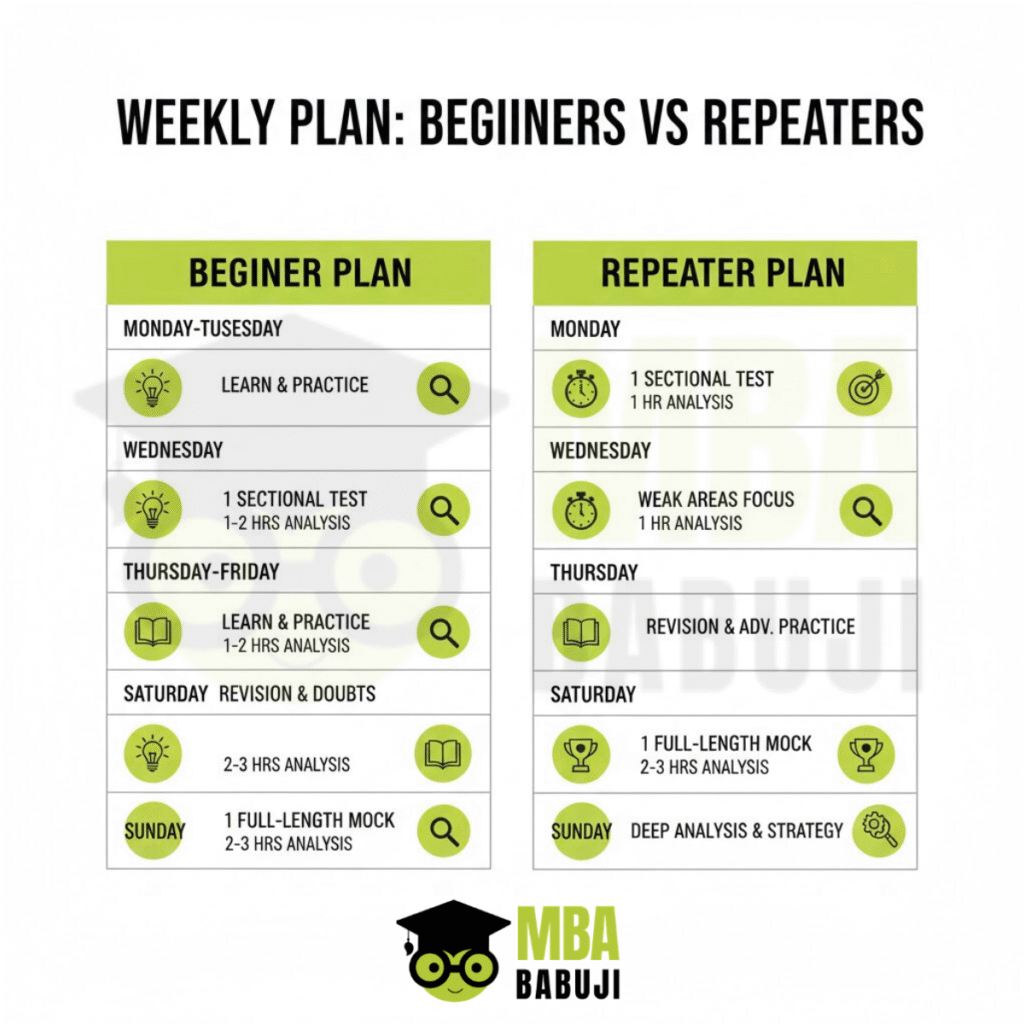
The Ideal Weekly Plan: Sectionals + Full Mocks
Here is a realistic weekly plan that works for most aspirants.
If CAT is 4–6 months away
- 1 full mock per week
- 2 sectionals per week
- 3 days topic practice
If CAT is 2–3 months away
- 2 full mocks per week
- 2–3 sectionals per week
- 2 days revision + weak topic practice
If CAT is 1 month away
- 3 full mocks per week
- 2 sectionals (only weak area)
- daily revision + error book
A Simple Rule: Sectionals Build Skills, Mocks Build Performance
If you remember one line, remember this:
Sectionals improve your section.
Full mocks improve your CAT percentile.
You need both.
But in the right sequence.
Conclusion: Start Smart, Then Go Full
If you are confused about whether to start sectionals or full mocks, don’t overthink.
Use this simple progression:
- Build basics
- Start sectionals early
- Shift to full mocks gradually
- Keep sectionals running for weak areas
- Analyse everything
The aspirants who improve are not the ones who give the most mocks.
They are the ones who follow the correct order and learn from every test.
FAQs
Q1. Should I start full mocks in the first month of CAT preparation?
If you are a beginner, start with sectional tests first. Give full mocks only once in 10–14 days initially.
Q2. How many sectional tests should I take every week?
For most aspirants, 2 sectionals per week is ideal. If DILR is weak, increase to 3.
Q3. When should I shift to full-length mocks regularly?
When you can handle 40 minutes per section without panic and have a basic attempt strategy. Usually, after 6–8 weeks of structured prep.
Q4. Are sectional tests enough to crack CAT?
No. Sectionals build skills, but full mocks build real exam performance, stamina, and percentile strategy. Both are required.