
How to Revise for CAT Without Forgetting Everything in 2 Weeks: Spaced Revision, Error Book & Weekly Revision Cycle
Revision is one of the most misunderstood parts of CAT preparation.
Most aspirants believe revision means “reading notes again” or “solving a few questions quickly”. But CAT is not a memory-based exam. It is a performance exam. Your score depends on how quickly you can recall methods, apply logic, and avoid repeating mistakes under time pressure.
That is why many serious aspirants face this frustrating situation:
They study consistently for weeks, feel confident, and then suddenly realise after 10–15 days that they have forgotten formulas, approaches, and even basic concepts.
This is not laziness. It is a revision system problem.
In this article, we will discuss the most practical way to revise for CAT without forgetting everything in two weeks, using three powerful tools:
- Spaced revision
- An error book (mistake tracker)
- A weekly revision cycle
This approach works for beginners, repeaters, and even students who are already giving mocks regularly.
Why CAT Aspirants Forget So Quickly (Even After Studying Properly)
Before fixing a revision, it is important to understand why forgetting happens.
CAT preparation involves:
- Quant formulas and concepts
- DILR patterns and set selection thinking
- VARC strategies, reading habits, and question traps
- Mock-based decision-making
The problem is that most students revise only when they feel they are forgetting. That is already too late.
Forgetting happens because:
- You are learning new topics daily, so older topics get pushed out
- You are revising passively (reading) instead of actively (testing)
- You are not revisiting weak areas frequently enough
- You are not tracking mistakes, so you repeat them
- You revise randomly, not cyclically
The result is that your preparation looks busy, but your retention becomes weak.
What Most Students Call “Revision” (And Why It Doesn’t Work)
Let’s be honest. Most CAT aspirants revise like this:
- They read formula sheets again
- They skim through coaching notes
- They re-watch videos at 2x speed
- They solve a few easy questions
- They “feel” they remember, but don’t test it
This revision style feels comfortable, but it does not build exam recall.
The real revision should do one thing:
It should make your brain retrieve information quickly.
CAT is a timed exam. You don’t get 5 minutes to remember a concept. You either recall it instantly or you lose the question.
So revision should be designed like a training system, not like a reading task.
The Real Solution: Revise in Cycles, Not in Long Sessions
If you want to avoid forgetting, your revision must happen in cycles.
That means:
- Small revision daily
- Medium revision weekly
- Deep revision monthly
This is the core idea behind spaced revision.
Step 1: Use Spaced Revision (The Only Method That Works Long-Term)
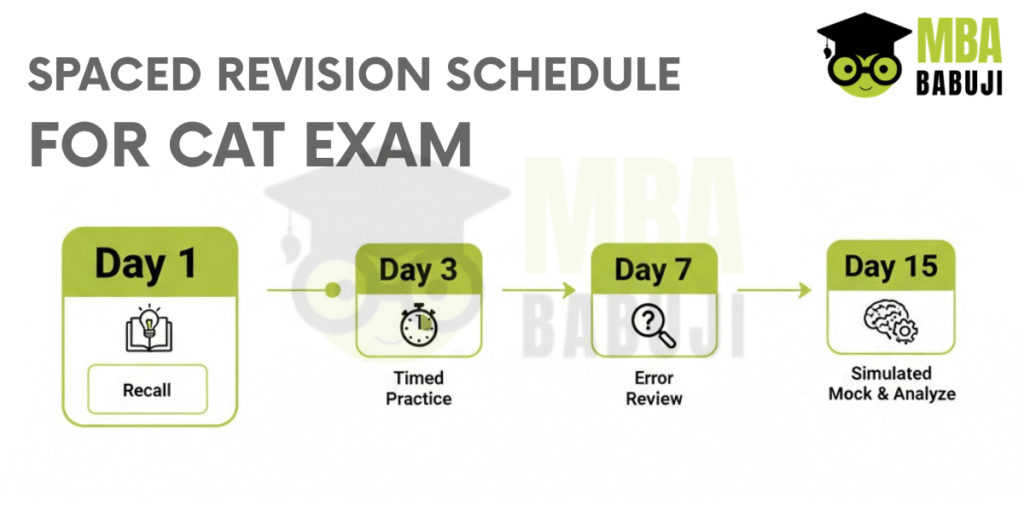
Spaced revision means revisiting a topic multiple times over increasing intervals.
Instead of revising one topic once for 2 hours, you revise it:
- 10 minutes today
- 10 minutes after 3 days
- 10 minutes after 7 days
- 10 minutes after 15 days
This creates long-term retention.
Why Spaced Revision Works for CAT
Spaced revision works because:
- It forces active recall
- It strengthens memory over time
- It prevents last-minute panic
- It keeps your weak topics alive
- It reduces the feeling of “starting from zero again”
For CAT, spaced revision is not optional. It is necessary.
Step 2: Create an Error Book (This Is Your Real Revision Material)
Your notes are not your best revision material.
Your best revision material is your mistakes.
This is where the error book comes in.
What Is an Error Book?
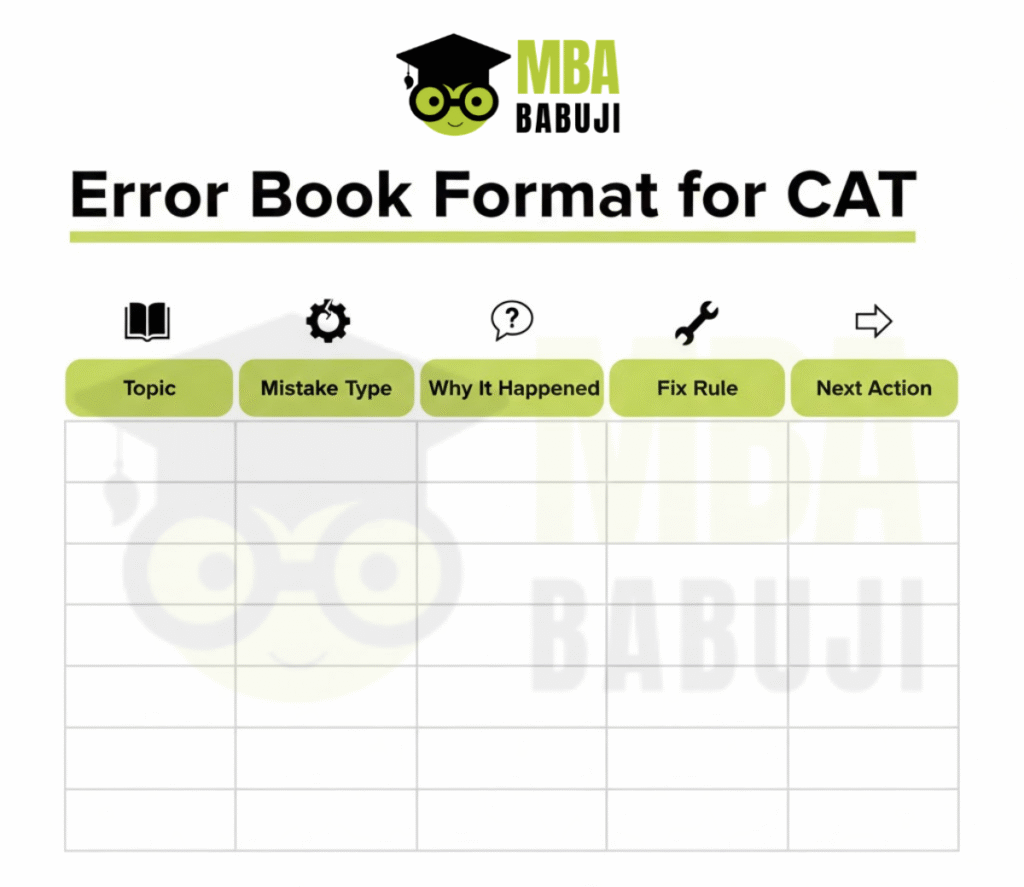
An error book is a simple record of:
- Questions you got wrong
- Questions you took too much time on
- DILR sets you chose wrongly
- VARC options you got trapped by
- Quant concepts you forgot under pressure
The error book helps you revise exactly what is costing you marks.
What to Write in Your Error Book (Simple Format)
You don’t need long writing.
Use a practical format like:
- Topic: Percentages / Time & Work / RC Inference
- Error Type: Concept / Calculation / Wrong approach / Time waste
- Why It Happened: Rushed/forgot formula/misread
- Correct Method: 1–2 lines
- Reminder Rule: “Check units first” / “Don’t assume.”
This takes 1–2 minutes per mistake, but saves hours later.
Why the Error Book Is So Powerful
Most aspirants revise what they already know.
But the CAT percentile improves when you reduce repeated mistakes.
The error book ensures:
- You stop losing marks in the same way
- You develop exam awareness
- You improve accuracy naturally
- Your revision becomes personalised
A topper’s revision is not bigger than yours.
It is more targeted than yours.
Step 3: Follow a Weekly Revision Cycle (The Missing Link)
Now comes the most important part.
Most students revise randomly, depending on mood.
Instead, follow a weekly revision cycle.
This ensures:
- Every topic gets revisited
- Weak areas get repeated more
- Strong topics stay fresh
- Revision never becomes overwhelming
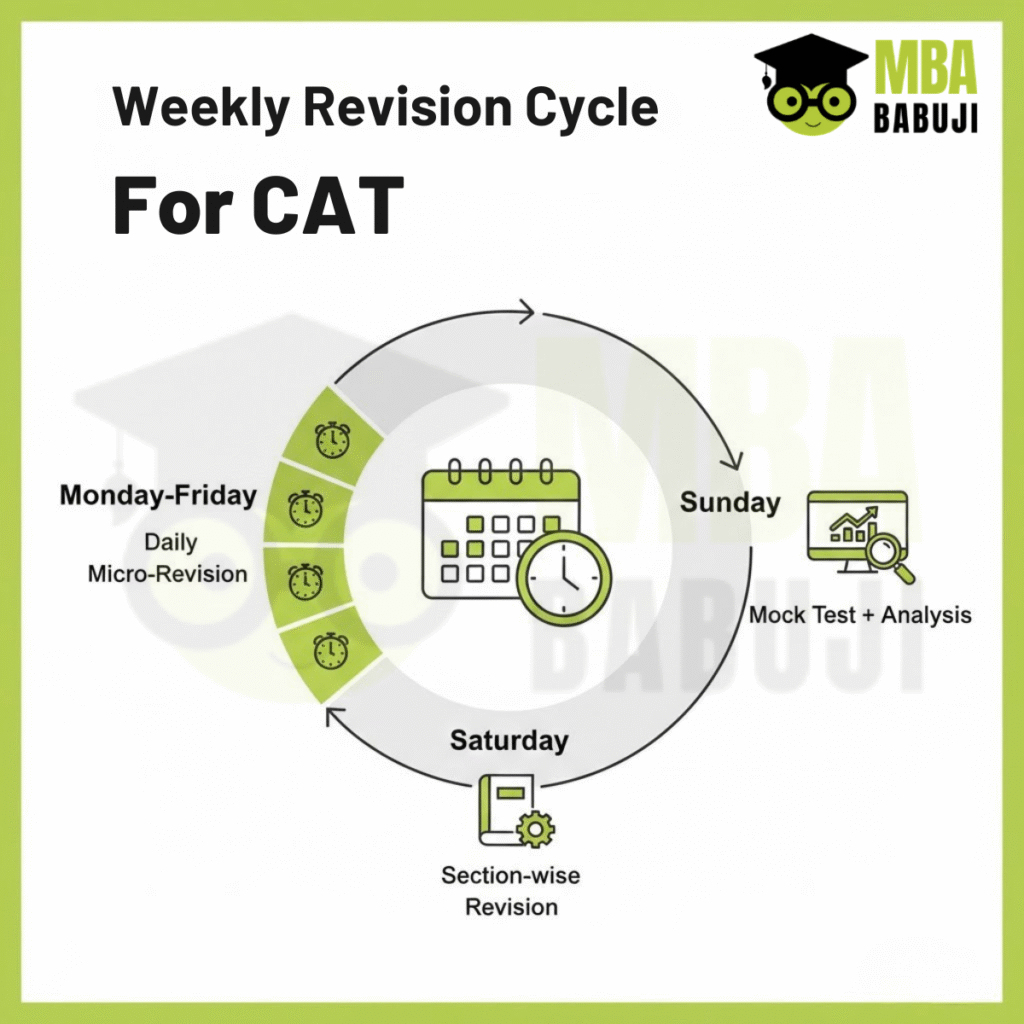
A Practical Weekly Revision Cycle for CAT (Works for Most Aspirants)
Here is a simple weekly structure you can follow.
Monday to Friday (Daily Micro-Revision)
Every day, do a 20–30 minute revision.
This can include:
- 10 minutes formula recall (Quant)
- 10 minutes error book review
- 10 minutes VARC trap pattern notes
Even if your schedule is busy, this micro-revision prevents forgetting.
Saturday (Section-wise Revision)
Saturday is ideal for section-wise revision.
For example:
- Week 1: Quant revision (2–3 topics)
- Week 2: DILR revision (set types + failed sets)
- Week 3: VARC revision (RC strategy + VA traps)
- Week 4: Mixed revision
This keeps the balance.
Sunday (Mock + Revision)
Sunday should ideally include:
- 1 mock test
- Mock analysis
- Revision of errors from the mock
This is the highest-value revision you can do.
How to Revise Quant Without Forgetting in 2 Weeks
Quant is the easiest section to revise, but students still forget because they revise incorrectly.
What Works for Quant Revision
Quant revision should include:
- Formula recall
- Short concept application
- Timed practice of 8–10 questions
- Review of error book
A good Quant revision session is not 2 hours of reading.
It is 45 minutes of recall + practice.
A Simple Quant Revision Routine (45 Minutes)
You can do it like this:
- 10 minutes: formula sheet recall (no reading, try to write)
- 25 minutes: 8 questions timed
- 10 minutes: review mistakes and update error book
This builds retention and speed together.
How to Revise DILR Without Losing Confidence
DILR is where revision becomes tricky.
Because DILR is not formula-based.
DILR revision should focus on:
- set selection thinking
- pattern familiarity
- table-making speed
- learning from failed sets
The Best DILR Revision Method
Instead of solving new sets daily, revise old sets like this:
- Take 2 previously solved sets
- Re-solve them in 50% time
- Identify the entry point again
- Compare your approach with the best approach
This improves speed and confidence.
What to Write in DILR Error Book
In DILR, don’t write long solutions.
Write:
- Set type
- Why you got stuck
- What was the correct first step
- When you should have left the set
This builds your decision-making.
How to Revise VARC Without Forgetting in 2 Weeks
VARC revision is not about memorising rules.
It is about:
- reading stamina
- question-type awareness
- trap option recognition
- consistent accuracy
What Works for VARC Revision
Your weekly VARC revision should include:
- 2 RC passages timed
- 8–10 VA questions
- review of wrong options
- notes on trap patterns
The goal is not to read more.
The goal is to understand why you chose the wrong option.
A Small VARC Error Tracker (Highly Recommended)
In your error book, track:
- Question type: inference / main idea / tone
- Wrong choice reason: extreme option / half-true / out of scope
- Correct rule: “Avoid absolute words”
Over time, this becomes your VARC revision guide.
The 3 Biggest Revision Mistakes CAT Aspirants Make
Even serious aspirants lose months due to these revision mistakes.
Mistake 1: Revising Only Before Mocks
Revision should be daily, not only before test days.
Mistake 2: Revising Strong Topics Too Much
Strong topics need maintenance. Weak topics need repetition.
Mistake 3: Not Revising Mistakes
If you don’t revise mistakes, your score will stagnate even after 20 mocks.
How to Use Revision Along With Mocks (Smart Integration)
Mocks are not separate from revision.
Mocks should decide your revision plan.
Here is a practical method:
- Give mock
- Analyse mock
- Identify top 3 mistakes
- Revise those 3 areas in the next 3 days
- Test again in the next mock
This creates a feedback loop.
That is how improvement becomes visible.
A Realistic 15-Day Revision Plan (For Students Who Feel They Forget Fast)
If you feel you forget everything quickly, follow this.
Day 1–5
- Quant: 1 topic revision daily
- DILR: 1 set type practice daily
- VARC: 1 RC + 5 VA daily
- Error book: 10 minutes daily
Day 6
- Sectional test (weakest section) + analysis
Day 7
- Revision day (only error book + formula recall)
Day 8–12
Repeat the cycle with different topics.
Day 13
Full mock + deep analysis
Day 14–15
Revise only mock mistakes + error book
This plan prevents forgetting and improves mock scores.
Conclusion: You Don’t Forget Because You’re Weak, You Forget Because Revision Is Random
If you want to revise for CAT without forgetting in two weeks, you don’t need more study hours.
You need:
- spaced revision
- an error book
- a weekly revision cycle
Once your revision becomes systematic, you will notice:
- faster recall
- fewer silly mistakes
- better mock stability
- stronger confidence without stress
In CAT, the most successful students are not the ones who study the most.
They are the ones who revise smartly and keep their preparation alive daily.
FAQs
Q1. How often should I revise topics for the CAT?
Use spaced revision. Revise a topic after 3 days, 7 days, and 15 days. Small repeated revision works better than long sessions.
Q2. What is an error book in CAT preparation?
An error book is a record of your mistakes from practice and mocks. It helps you revise what actually reduces your score.
Q3. How much time should I spend on revision daily?
Even 20–30 minutes daily is enough if it is structured. The goal is consistency, not long revision hours.
Q4. Should revision be separate from mock preparation?
No. Your mock analysis should decide what you revise next. Mocks and revision should work as one system.