
Why Smart MBA Aspirants Still Miss Top Percentiles: Common Mistakes in CAT & MAH-CET
Every year, hundreds of thousands of aspirants prepare for MBA entrance exams like CAT, MAH-CET, XAT, SNAP, and yet many capable students fall short of the top percentiles. The reason is rarely a lack of knowledge—it’s often due to strategic errors, improper time management, or small mistakes during the exam. Even top performers who are strong in certain sections sometimes lose valuable marks that push them below the 95–99 percentile.
Understanding these pitfalls and adopting smart exam strategies can help aspirants cross the top percentile barrier.
Overconfidence in “Strong” Sections
Many aspirants excel in one or two sections (Quant or VARC) and assume that high scores there will compensate for weaker areas. Unfortunately, entrance exams have sectional cut-offs and balanced scoring matters:
- Example: A candidate scoring 99 percentile in Quant but 70 percentile in VARC may end up with an overall 92–93 percentile, which may not be enough for top B-schools.
- Students often skip or rush weak sections, causing careless mistakes.
Tip: Create a section-wise improvement plan. Even if you are weak in a section, aim for average+ scores to prevent low-percentile drag.
Ignoring Mock Test Analysis
Many aspirants rely on mocks only for practice but don’t analyze their performance in depth. This is one of the biggest reasons high-performers underachieve.
- Common errors:
- Repeating the same mistakes across multiple mocks.
- Not tracking accuracy vs attempts.
- Ignoring time spent on low-yield questions.
- Advanced tip: Maintain a mock analysis sheet with:
- Question type & difficulty
- Time taken
- Correct/incorrect
- Strategy for next mock
Pro Tip: Mocks are only useful if each error is converted into a concrete learning point.
Overattempting Questions
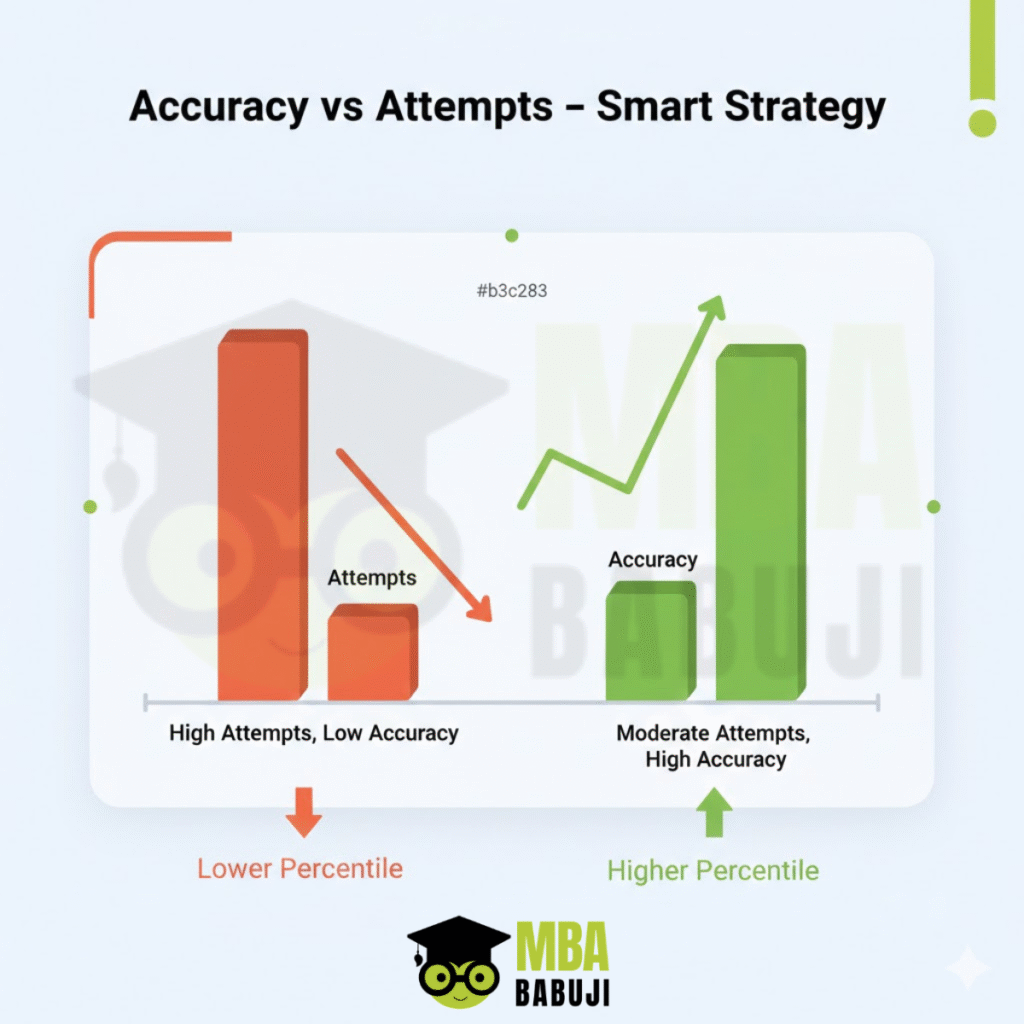
Attempting more questions doesn’t always improve percentile; in fact, low accuracy penalizes the overall score.
- Example: In CAT 2025, a student attempted 90 questions at 60% accuracy scoring 144 marks. Another student attempted 65 questions at 80% accuracy scored 148 marks and secured higher percentile.
- Blind guessing or overconfidence in tough questions can reduce effective scores.
Tip: Prioritize high-confidence questions first, leaving low-confidence ones for later if time permits. Use elimination techniques to increase accuracy.
Poor Time Management
Time management is one of the most common pitfalls for top aspirants:
- Spending 15–20 minutes on one tricky question.
- Ignoring sectional timing strategy.
- Last-minute panic in the final 10 minutes.
Solution:
- Allocate time per question based on difficulty and scoring potential.
- Follow a planned pace during mocks to simulate real exam pressure.
- Keep buffer time for checking answers or attempting tricky questions later.
Neglecting Revision & Short Notes
Memorization without revision often leads to forgotten formulas, shortcuts, and concepts, especially under exam stress.
- Quant formulas or LRDI shortcuts may be forgotten under pressure.
- Vocabulary and reading comprehension strategies degrade if not revised.
Solution:
- Maintain concise revision notes or flashcards.
- Dedicate 15–20 minutes daily for reviewing formulas, high-frequency concepts, and weak question types.
Mental Fatigue and Stress
Even well-prepared aspirants can underperform due to mental fatigue, exam stress, or over-preparation.
- Stress can result in misreading questions or careless errors.
- Overworking just before exams can reduce focus and retention.
Solution:
- Practice timed mock sessions with breaks.
- Include meditation, light exercise, and proper sleep in your routine.
- Simulate exam conditions in mocks to adapt to stress.
Lack of Strategy for Question Selection
Many students approach CAT or MAH-CET with uniform effort for all questions, instead of prioritizing:
- High-scoring questions first (easy and high-confidence)
- Time-intensive or tricky questions later
- Ignoring question selection strategy leads to low efficiency and wasted time.
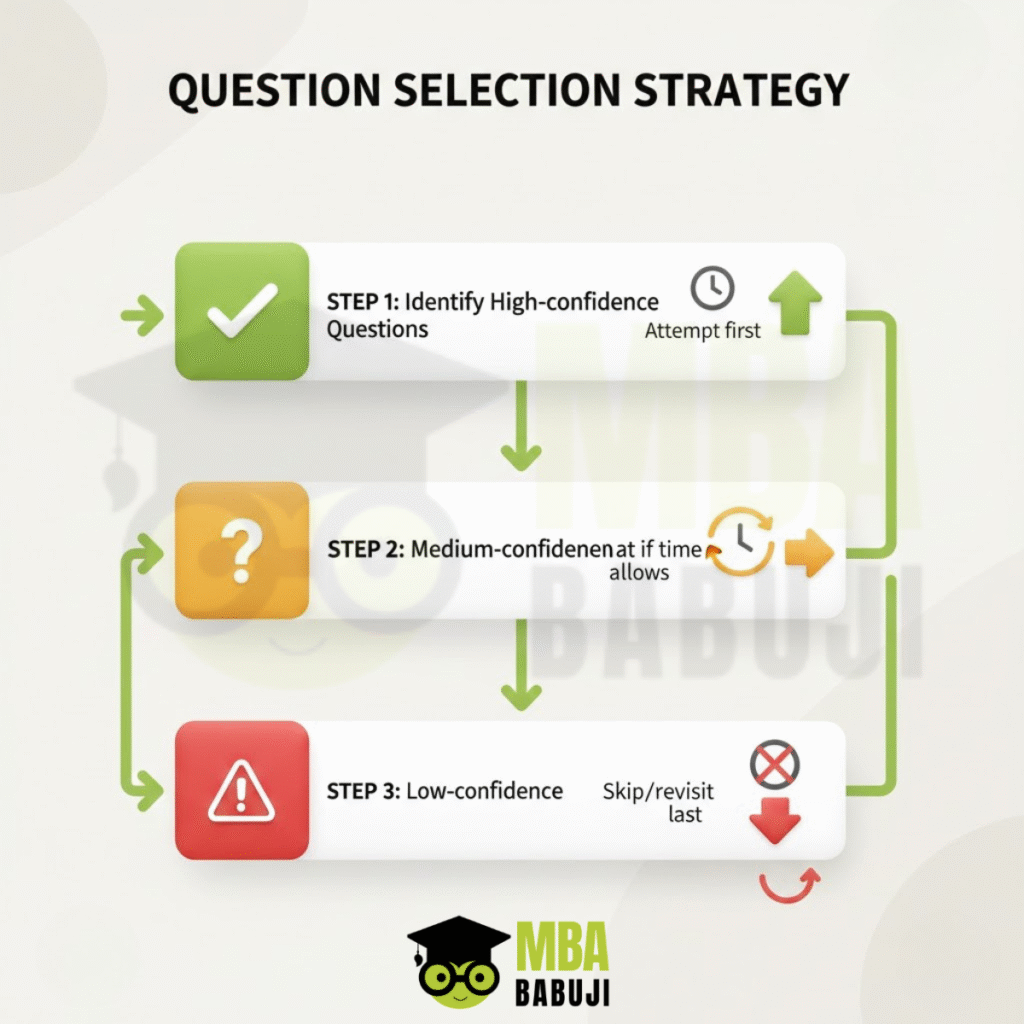
Tip: Divide questions into 3 categories during mock practice:
- High-confidence, high-scoring → Attempt first
- Medium-confidence → Attempt if time allows
- Low-confidence → Skip initially; revisit only if time permits
Key Takeaways
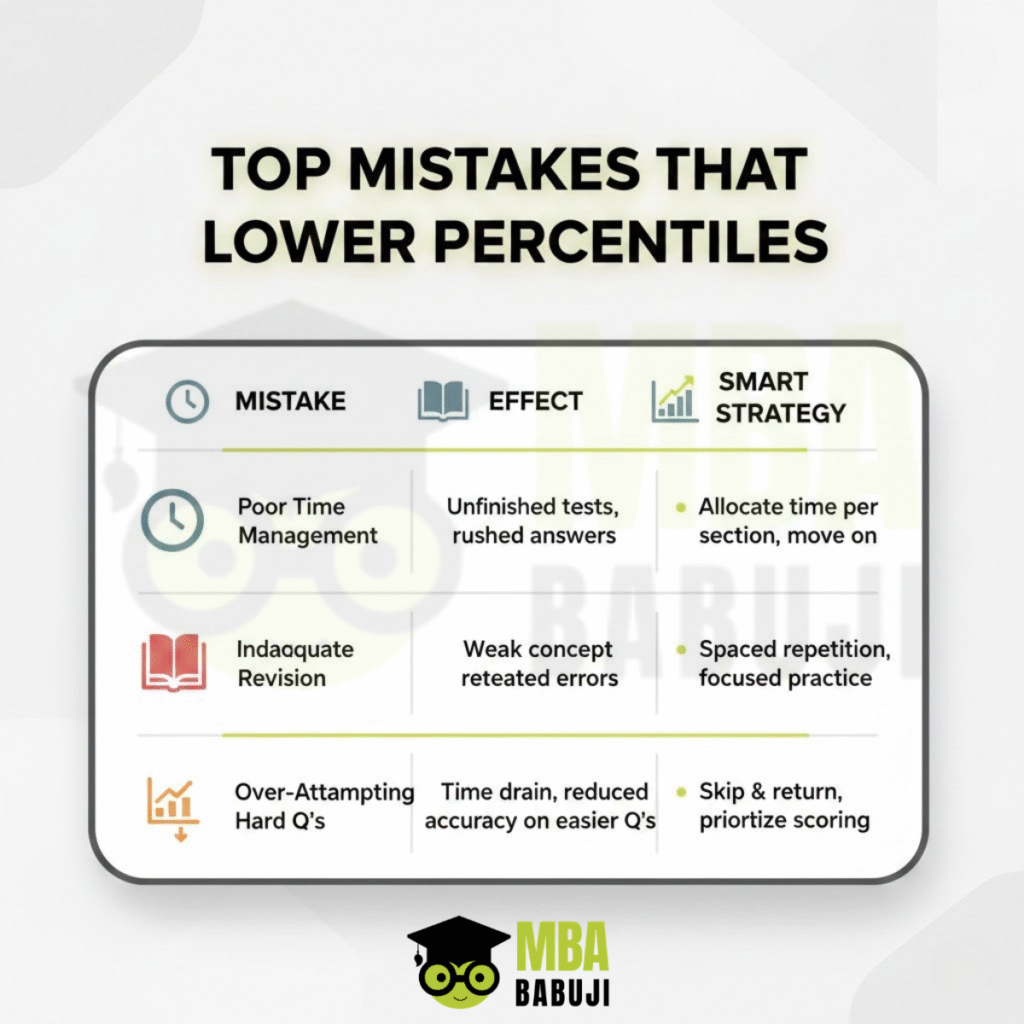
| Mistake | Effect | Smart Strategy |
|---|---|---|
| Overconfidence in strong sections | Imbalanced overall score | Focus on consistent performance |
| Ignoring mock analysis | Repeating errors | Track performance & adapt |
| Overattempting | Lower accuracy, percentile drop | Prioritize high-confidence questions |
| Poor time management | Panic, rushed mistakes | Stick to planned timing per section |
| Neglecting revision | Forgetting formulas & concepts | Short notes + daily review |
| Mental fatigue | Reduced focus & performance | Mock simulation + rest & meditation |
| Stick to the planned timing per section | Low efficiency | Categorize & prioritize questions |
FAQs
Q1. Can a single weak section ruin my CAT/MAH-CET percentile?
Yes. Sectional balance is crucial; a low score in one section can significantly impact the overall percentile.
Q2. How many mocks should I attempt?
15–20 full-length mocks are ideal. Focus on the quality of analysis more than quantity.
Q3. Should I attempt all questions?
No. Accuracy over quantity is the key. Smart attempts yield a higher percentile.
Q4. How to manage exam stress effectively?
Use timed mocks, meditation, light exercise, proper sleep, and maintain calm during the exam.